
SA100A8/A9 (calprotectin) levels in patients with acute myocardial infarction compared with stable CAD
2Faculty of Health Sciences, Ben-Gurion University of the Negev, Beer Sheva, Israel, Israel
Introduction
SA100A8/A9, a complex of proteins known as calprotectin, is expressed constitutively in neutrophils and monocytes. During inflammation calprotectin is actively released stimulating recruitment of other leukocytes and cytokines release. Accumulating evidence suggests that inflammatory response during atherosclerotic coronary artery disease (CAD), and especially during acute myocardial infarction (AMI) induces the recruitment of white blood cells and the release of inflammatory proteins including calprotectin. Furthermore, calprotectin is transferred from neutrophils to platelets during the acute phase of AMI. Our aim was to compare the level of S100A8/A9 (calprotectin) between patients with AMI and patients with stable CAD.
Materials and methods
We enrolled 20 patients with non-ST elevation AMI within 24 hours of admission before cardiac catheterization, and 20 patients with stable CAD. Blood samples were collected in heparin tubes and plasma was collected by centrifugation within 30 minutes. S100A8/A9 levels were quantified by ELISA.
Results
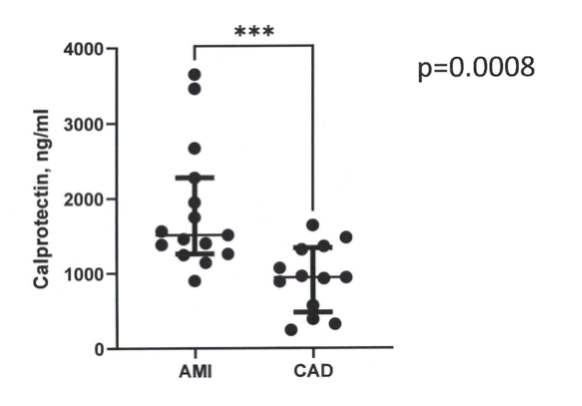
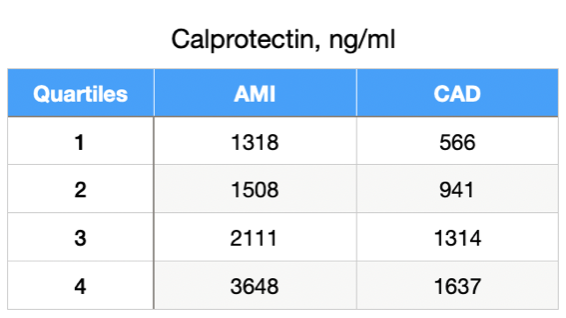
Twenty patients with NSTEMI were enrolled in the study (mean age 64.6±13 years, 85% men, 40% diabetes) were compared to 20 patients with stable CAD (mean age 66.6±14, 80% men, 30% diabetes). The median S100A8/A9 protein plasma level in patients with AMI was 1508 (IQR 1318-2111) ng/ml, which was significantly higher than in patients with CAD (941 (IQR 566-1314) ng/ml, p=0.008). The first quartile of S100A8/A9 levels in patients with AMI (below 1318 ng/ml) overlaps with the 3rd quartile in patients with CAD (above 1314 ng/ml).
Conclusion
Circulating S100A8/A9 protein (calprotectin) appears to be significantly augmented in patients with AMI compared with patients with stable CAD. Further studies should assess the diagnostic and prognostic value of S100A8/A9 in the early stages of AMI.
israelheart@ortra.com מייל לשאלות
