
A New In-Vitro Model of the Infarct Border Zone Insights into Ventricular Arrhythmias and Reentrant Circuits Development
2Cardiology Department, Rambam Health Care Campus, Israel
Introduction: Post-infarction ventricular arrhythmias(VA) are associated with to slowly conducting viable strands within the infarct border zone(IBZ). We developed a simplified in vitro model of the IBZ using photolithography-based micropatterning and human-induced pluripotent stem cell-derived cardiomyocytes (hiPSC-CMs) to study VA.
Material and method: hiPSC were differentiated into ventricular myocytes and seeded onto a 2D micropatterned IBZ model. This involved anti-fouling coating, laser-patterning a photoinitiator gel, ECM coating, and cell seeding. Optical mapping during pacing assessed conduction and geometry`s effects on arrhythmogenesis Characterization.
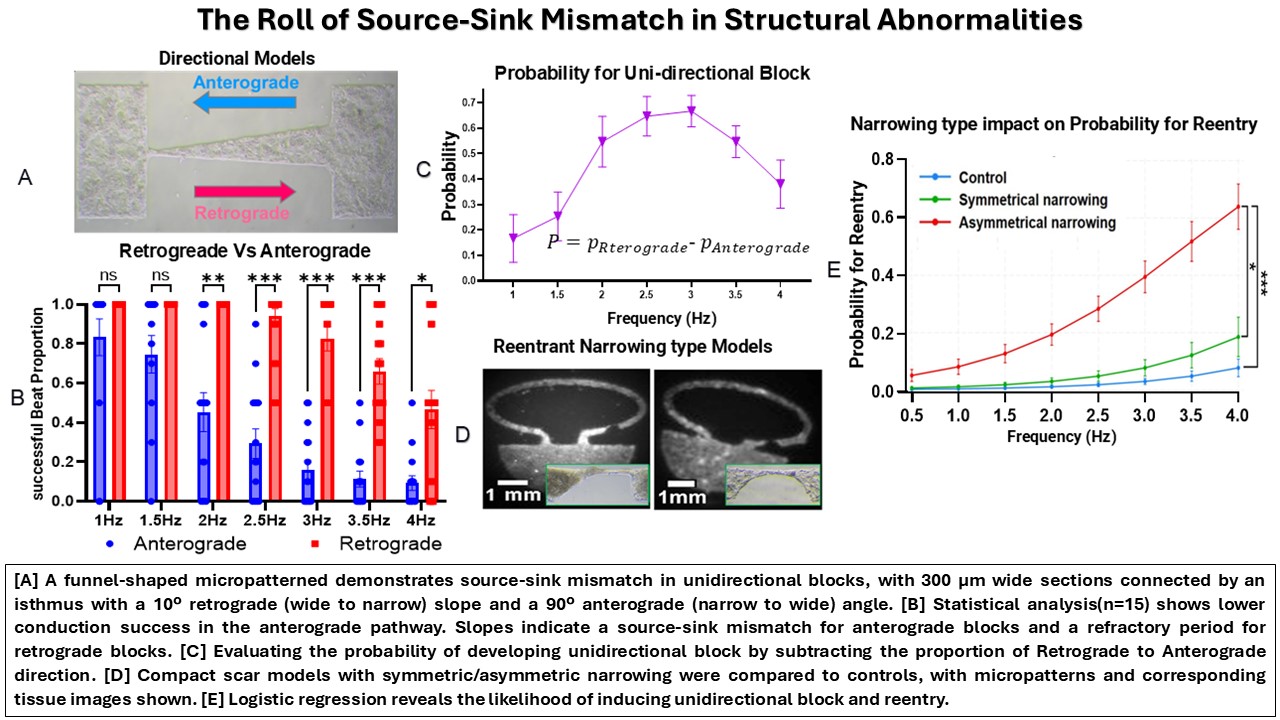
Results and discussion: Initially, we used micropatterning to study how geometric properties affect conduction and sync/source mismatches in a narrow funnel-shaped conducting fiber(Fig.A), simulating the IBZ-related isthmus. Retrograde(wide to narrow) vs. anterograde(narrow to wide) conduction was examined by pacing at increasing rates(Fig.B). Significant differences emerged at 2 Hz(p=0.03), showing 100% successful propagation retrogradely compared to only 45% anterogradely(55% conduction block). Comparing graph slopes suggested that conduction block in the anterograde direction(at slow pacing rates) was due to source-sink mismatch, while retrogradely(fast rates) it was related to refractory period block(Fig.B). The probability for uni-directional block, defined by subtraction of retrograde from anterograde block probability, resulted in a concave plot with maximal probability of 65% at 2.5-3Hz(Fig.C). Next, we studied a “basket-shape” model of the IBZ with a conducting strand featuring symmetric or asymmetric narrowing versus a control model without narrowing(Fig.D). The incidence of reentry following rapid pacing in the asymmetrical group was high(Fig.E), while in the symmetrical group it was low and did not differ from control. Procainamide administration had no effects in the symmetric narrowing, but substantially reduced reentry in the asymmetric narrowing.
Conclusion: A novel in-vitro model of the IBZ was generated, highlighting how structural inhomogeneities contribute to conduction blocks and arrhythmogenesis, likely due to source/sink mismatches. This approach offers new insights into arrhythmia mechanisms and treatments.
israelheart@ortra.com מייל לשאלות
