
Age Dependent Risk of Long-term All-cause Mortality in Patients Post Myocardial Infarction and Acute Kidney Injury
2Faculty of Medicine, Tel Aviv University, Israel
3Nursing, Ben-Gurion University of the Negev, Israel
4Neonatal Intensive Care, Sheba Medical Center, Israel
5Medicine, Harvard Medical School, USA
6Goldman Medical School, Ben-Gurion University of the Negev, Israel
7Emergency Medicine, Soroka University Medical Center, Israel
Introduction. We aim to investigate the association between acute kidney injury (AKI) and the risk for long-term (up-to 10 years) all-cause mortality among elderly compared to young patients following acute myocardial infarction (AMI).
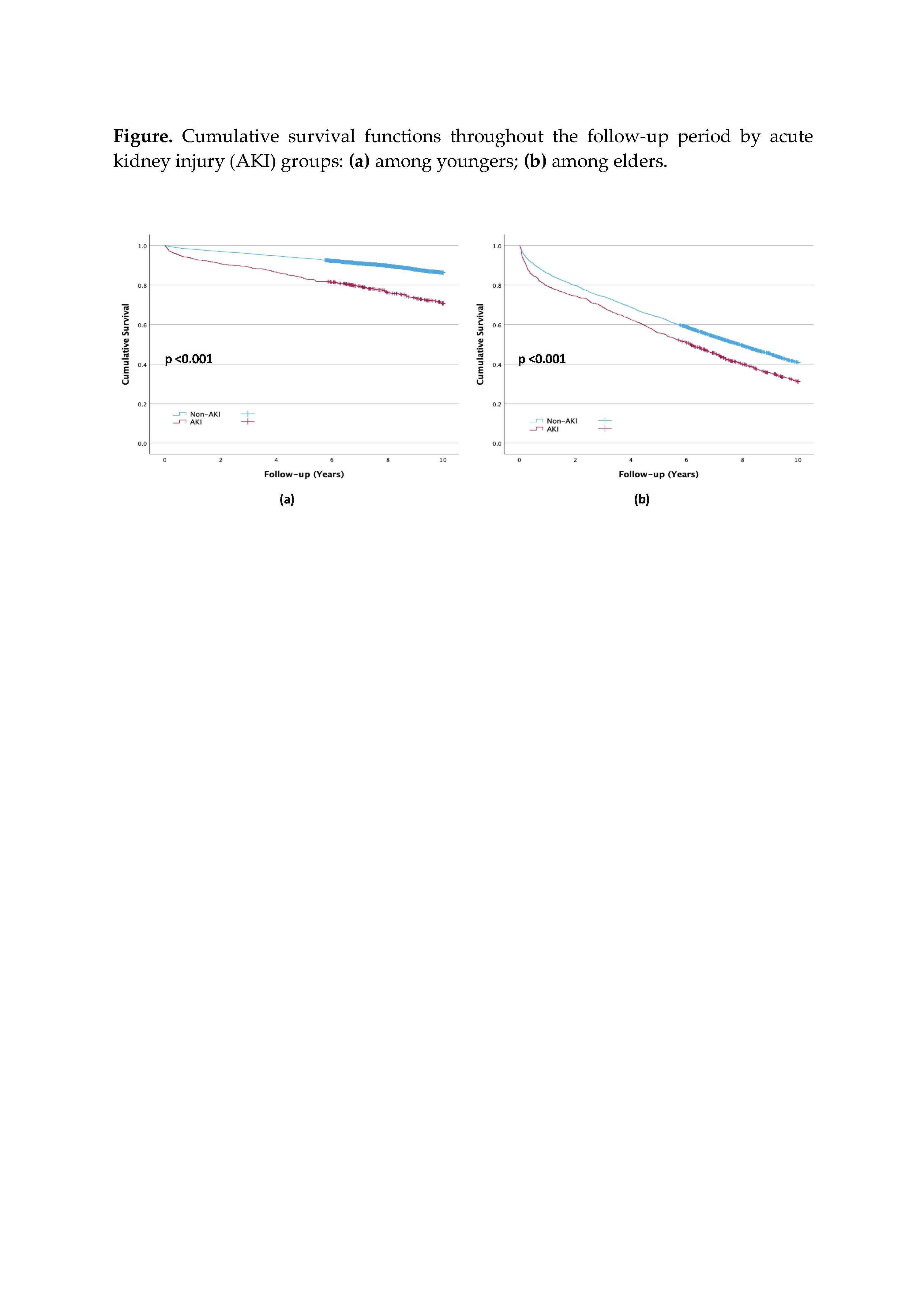
Material and Methods. The study is a retrospective analysis of the Soroka Acute Myocardial Infarction registry, covering the years 2002 to 2017. It includes patients diagnosed with AMI who had a baseline Estimated Glomerular Filtration Rate (eGFR) greater than 60 mL/min/1.73m² and serum creatinine measurements available during hospitalization. Patients were stratified by age: elderly (aged 65 years or older at admission) and young. In each stratum, two groups were defined, based on the presence of AKI. Survival approach was utilized to estimate and compare the probability of long-term (up-to 10 years) all-cause mortality in each group.
Results. Among the 10,511 eligible patients, consisting of 6,132 younger patients (58.3%) and 4,379 elderly (41.7%). AKI occurred in 15.2% of cases, with elderly patients experiencing a higher incidence than younger patients (20.9% vs. 11.2%, p<0.001). The presence of AKI significantly increased the risk of death in both age groups (see Figure), with the association being stronger among younger patients (AdjHR=1.634, 95% CI: 1.363-1.959, p<0.001), than among the elderly (AdjHR=1.278, 95% CI: 1.154-1.415, p<0.001), p-for-interaction=0.020.
Conclusions. AKI following AMI was associated with high risk for long-term all-cause mortality in both age groups, with a stronger association among younger patients.
israelheart@ortra.com מייל לשאלות
