
Competing Risk of Ventricular Tachyarrhythmias and Mortality in Advanced Heart Failure Patients
2Clinical Cardiovascular Research Center, University of Rochester Medical Center, USA
Background:
Patients with heart failure and low left ventricular ejection fraction (LVEF) are at higher risk of death from ventricular tachycardia or ventricular fibrillation (VT/VF), pump failure, or non-cardiac causes. This study aimed to assess the association between LVEF and VT/VF risk, considering non-arrhythmic mortality as a competing factor.
Methods
The study comprised 5,168 primary prevention ICD recipients from five major trials (MADIT-II, MADIT-CRT, MADIT-RIT, MADIT-RISK, RAID), categorized by LVEF tertiles (EF ≤20%, EF 21-29%, EF 30-35%). Outcomes included VT/VF, VT over 200 BPM or VF, appropriate ICD shocks, and mortality, with Fine and Gray regression models used to adjust for death as a competing risk in arrhythmia outcomes.
Results
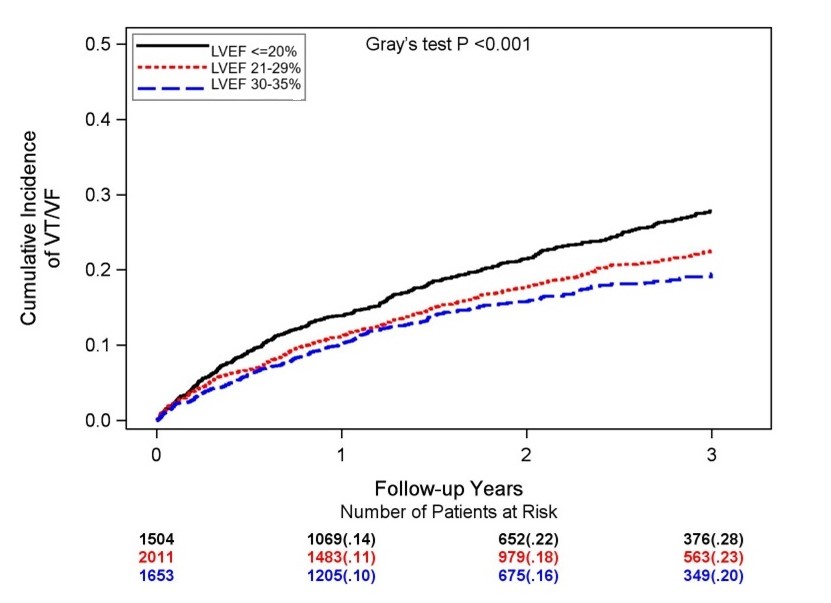
At 3 years of follow-up, the cumulative incidence of VT/VF was 28% in patients with LVEF ≤20% (n=1504), 23% in those with LVEF 21–29% (n=2011), and 20% in the LVEF 30-35% (n=1653) group (Gray’s test, p<0.001, Figure). Multivariate analysis revealed that compared to patients with LVEF >20%, patients with LVEF ≤20% had significant 23% increased risk of VT/VF (p=0.004), 33% increased risk of fast VT/VF (p=0.001), and 31% increased risk of appropriate ICD shocks (p=0.003), even after accounting for competing risks of death. This increased VT/VF risk in lower LVEF patients was consistent across different subgroups, including age, sex, presence of CRT-D, and non-ischemic cardiomyopathy. Additionally, patients with LVEF ≤20% had a 1.5-fold higher risk of all-cause mortality compared to those with LVEF >20% (p<0.001).
Conclusions:
Patients with very low LVEF show a markedly increased risk of VT/VF and ICD shocks, even when considering the competing risk of non-arrhythmic mortality, confirming the potential benefit of ICD therapy in this high-risk population.
israelheart@ortra.com מייל לשאלות
