
How lactate dehydrogenase levels preimplantation affect outcomes of left ventricular assist devices
2Department of Cardiology, Leviev Heart Center, Chaim Sheba Medical Center, Tel-Hashomer, Affiliated with the Sackler School of Medicine, Tel Aviv University, Israel, Israel
Background: Lactate dehydrogenase (LDH) is a critical marker of tissue perfusion and metabolic status. Elevated pre-HM3-LVAD LDH often reflects severe tissue hypoperfusion, common in advanced heart failure, while postoperative elevations may indicate device issues, infection, or thromboembolic events. Postoperative normalization of LDH is linked to improved organ function and long-term survival. Monitoring LDH trends can help detect complications, optimize device function, and enhance HM3-LVAD patient management.
Methods- From 2016 through 2024, 170 adult patients were implanted with the HM3-LVAD. Among them were 115 patients with a pre op LDH of 0-450 U/L (low group) and 55 patients with a pre-op LDH > 450 U/L (high group).
Results- The low group’s mean age was 59 years, and the high group was 58 years (p= 0.49). In the low group, 94 (82%) were male and 21(18%) were female. In the high group, there were 46 (84%) males and 9 (16%) females (p= 0.95). The low group included 89 (77%) patients who were BTT whereas there were 41 (63%) patients who were BTT in the high group (p= 0.06). We observed the preoperative (Table 1), intraoperative, and postoperative characteristics (Table 2) as well as short-term and medium-term mortality rates (Table 3). Survival rates at 30 days, 6 months, and 12 months post-implantation were 91%, 84%, and 80% in the low group, compared to 89%, 76%, and 76% in the high group (p=0.90, 0.45, 0.86).
Conclusions: Elevated LDH before HM3-LVAD implantation did not significantly affect survival but was associated with higher morbidity, including gastrointestinal bleeding and respiratory failure. Preoperative LDH assessment can guide clinical decision-making and preparation for potential complications. Each case should be evaluated holistically to optimize outcomes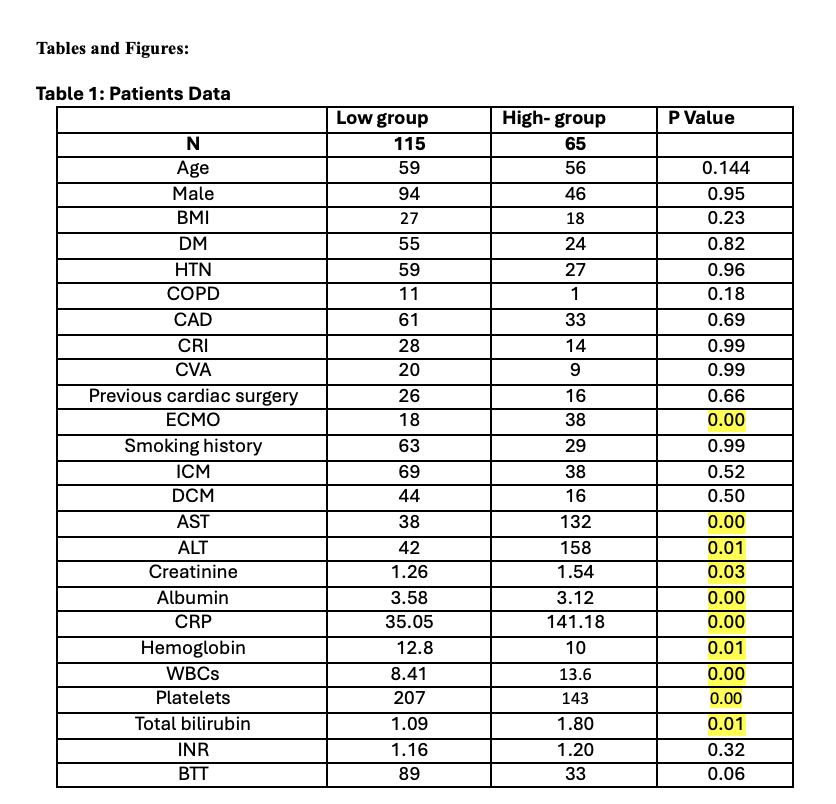 .
israelheart@ortra.com מייל לשאלות
