
Head-to-Head Comparison of Semaglutide and Colchicine for Treating Atrial Remodeling in Post-MI Rats with Reduced Ejection Fraction
2Regenerative Medicine & Stem Cell Research Center, Ben-Gurion University of the Negev, Israel
3Department of Physiology and Pharmacology, Tel Aviv University, Israel
4Cardiology Section, Soroka University Medical Center, Israel
5Samson Assuta Ashdod University Medical Center, Cardiology Department, Israel
Introduction: Atrial fibrillation (AF) is closely linked to poor clinical outcomes, particularly in patients with heart failure (HF). Inflammation and fibrosis are critical in the development of atrial remodeling, a complex process that ultimately increases AF susceptibility. Current AF therapies are suboptimal and do not effectively target atrial remodeling. Colchicine, a broad-spectrum anti-inflammatory drug approved for various indications, and semaglutide, a GLP-1 receptor agonist approved for diabetes and obesity, may exert direct and indirect cardiac effects. This study evaluates their potential to prevent atrial remodeling in post-MI rats with reduced ejection fraction (EF).
Methods: Male rats underwent left coronary artery ligation and chronic electrophysiological device implantation including an atrial quadripolar electrode and peripheral ECG leads. After a 1-week recovery, rats with EF≤40% were randomly assigned to receive semaglutide (40 μg/kg/72h SC), colchicine (100 μg/kg/24h IP), or vehicle (saline Q24h IP) for 3 weeks. The doses were selected based on efficacy for other indications in rats. Post-treatment assessments included echocardiography, electrophysiological testing, histology, and Western blot analysis.
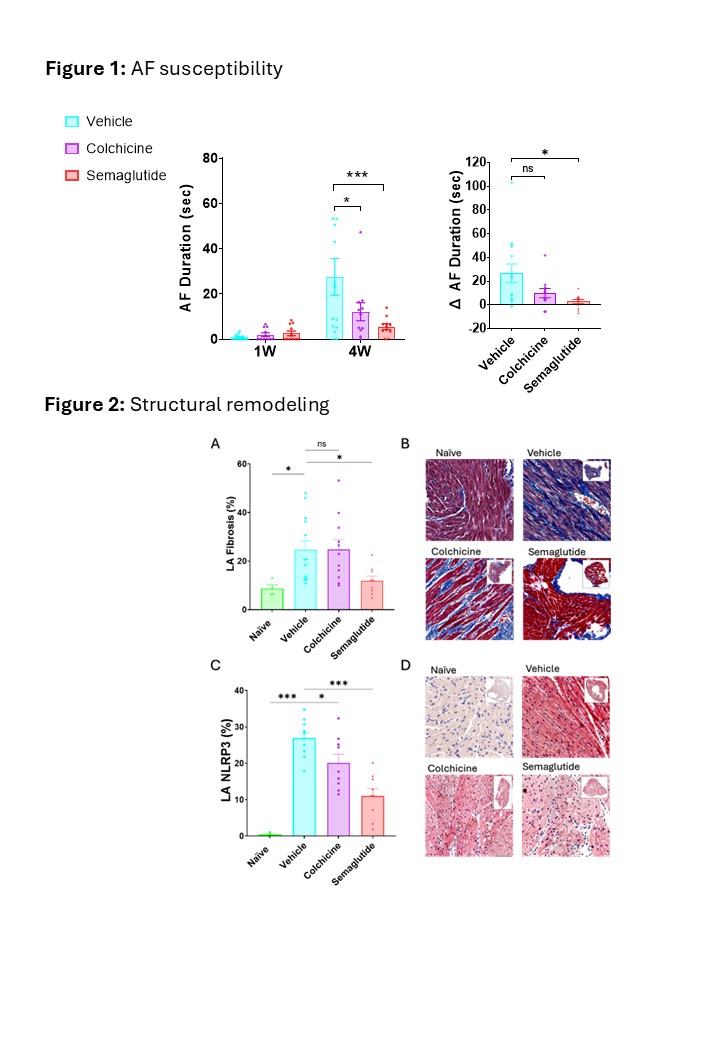
Results: Neither semaglutide nor colchicine improved HF parameters, including left ventricular EF and left atrial diameter. However, semaglutide and, to a lesser extent, colchicine reduced AF inducibility and total AF duration compared to the vehicle (Fig 1). Semaglutide, markedly decreased atrial NLRP3 inflammasome expression and fibrosis, while colchicine reduced NLRP3 expression but did not affect fibrosis (Fig 2). Immunofluorescence revealed that semaglutide also prevented the lateralization of connexin 43 as opposed to colchicine. Western blot analysis indicated that colchicine reduced p38 signaling, while semaglutide tended to reduce IL-18, downstream to NLRP3.
Conclusions: Both semaglutide and colchicine exhibited anti-inflammatory effects in the atria of post-MI rats. However, semaglutide was superior in preventing atrial fibrosis and in reducing AF susceptibility, highlighting its potential anti-AF effects beyond the context of diabetes and obesity treatment.
israelheart@ortra.com מייל לשאלות
