
Beyond the Initial Insult: Clinical Characteristics and Prognosis of Heart Failure with Improved Ejection Fraction
Introduction: Heart Failure with Improved Ejection Fraction (HFimpEF) is a recently defined subtype of HF, characterized by an increase in ejection fraction (EF) after a prior diagnosis of reduced EF. There are limited data on the characteristics and outcomes of this patient subset. The study aimed to investigate the clinical profile and prognosis of this patient group.
Methods: HFimpEF patients from a large echocardiography database with comprehensive clinical and outcome data were evaluated for clinical characteristics and outcomes, including mortality and cardiovascular hospitalizations. HFimpEF was defined as a prior HF diagnosis with EF ≤40% followed by an EF increase of ≥10% to >40%.
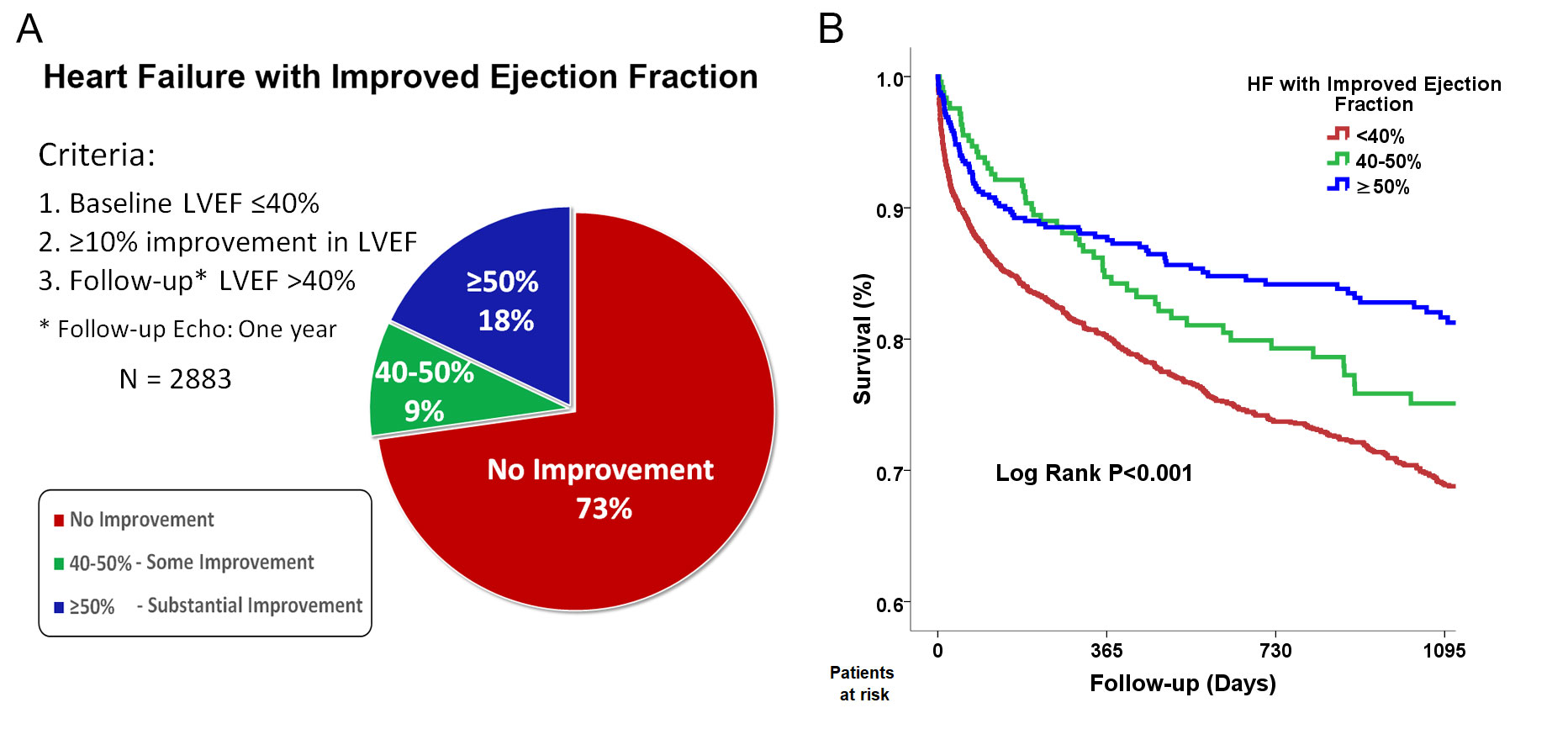
Results: The study included 2,883 patients with an EF ≤40%. Twenty-seven percent (777) fulfilled the criteria for HFimpEF (Figure A). Non-ischemic cardiomyopathy, female sex, and smaller left ventricular dimensions were associated with EF improvement. The median follow-up duration was 1,346 days. Patients with HFimpEF had a significantly improved prognosis compared to those without EF improvement (Figure B). Patients with a significant improvement in EF (≥50%) experienced a 30% lower mortality rate by multivariable Cox regression analysis (HR 0.70, 95% CI 0.57-0.86, P<0.001) and a decreased risk of cardiovascular hospitalizations.
Conclusions: HFimpEF is a distinct clinical entity observed in 27% of patients with initially reduced EF and confers a better prognosis. However, even with improvement, EF in most patients does not fully recover, and clinical events can still occur.
Figure A. Prevalence of HFimpEF stratified into improvement of EF to 40-50% and improvement to ≥50%.
Figure B. Kaplan-Meier survival analysis stratified by changes in EF. Survival was significantly higher in patients with HF and improved EF (EF 40-50% and EF ≥50%) compared with persistent HFrEF (<40%) (Log-rank test, P<0.0001).
israelheart@ortra.com מייל לשאלות
