
Challenging the guidelines: does left ventricle diameter and function change significantly in long term follow-up of patients with severe aortic regurgitation?
Background: Guidelines suggest aortic valve surgery in patients with chronic severe AR and progressive increase in left-ventricle-end-diastolic-diameter(LVEDD) or progressive decrease in LV function.
Purpose: determine the rate of change in LVEDD, LVESD and fractional-shortening (FS) in patients with chronic AR.
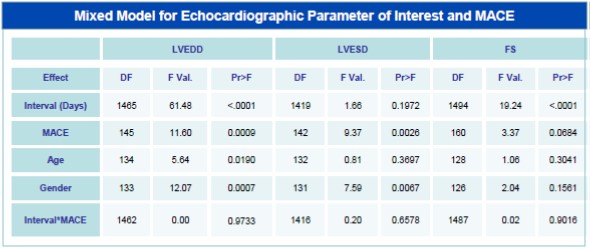
Methods: patients with>moderate AR on index-echo and at least three consecutive studies over≥1.5 years between 4/1994-4/2024, excluding ≥moderate aortic/mitral stenosis, aortic dissection, previous aortic/mitral surgery, hypertrophic-cardiomyopathy or complex congenital-heart disease. Major adverse cardiac events were AVR, acute heart-failure hospitalization or all-cause-mortality. A mixed model with repeated measures was conducted to examine the relationship between the dependent variable and independent variables, assessing the interaction effect of the independent variables with time, adjusted for age and gender.
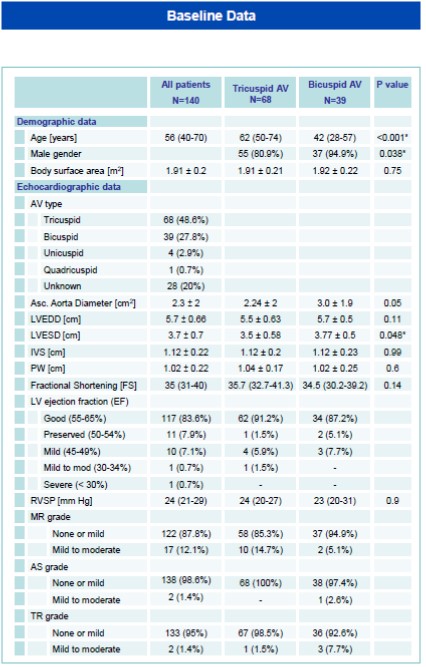
Results: 140 patients met inclusion criteria. Median follow-up was 4.4 years (interquartile range (IQR) 1.9-8.8 years), median interval between consecutive studies was 255 days(IQR 172-367 days), median number of studies per patient were 7 (IQR 3-11). Thirty five(25%) patients died and 61(43.6%) patients underwent aortic valve replacement AVR (56 surgical and 5 trans-catheter). Eight patients(5.7%) were admitted with acute heart failure. Median survival was 18 years(IQR 9-18.5 years), median time to AVR was 11.8 years(IQR 6-16.4 years). Partial correlation coefficients and p values for LVEDD, LVESD, and FS were respectively -0.04, -0.0013, and -0.056, all non-significant. AS grade, TR grade and RVSP increased significantly with time (R values were 0.41, 0.21 and 0.28, all p values<0.001). Mixed model analysis did not reveal a significant change in LVEDD/LVESD/FS values over cumulative interval periods in interaction with MACE, whereas AS-grade, TR-grade and pulmonary pressure worsened.
Conclusions: We did not find a significant change in left-ventricle diameter, FS or EF in patients with significant AR followed up over a long time period affecting MACE, casting doubt on the clinical utility of change in these parameters in clinical practice.
israelheart@ortra.com מייל לשאלות
