
Human Mesenchymal Stromal Cells from the Left Ventricle Participate in Heart-Tumor Interactions
2Lev Leviev Cardiovascular and Thoracic Center, Sheba Medical Center, Tel Hashomer, Israel
3Cardiothoracic Surgery department, Sheba Medical Center, Tel Hashomer, Israel
4Cardiothoracic Surgery department, Assuta Medical Center Ramat Hahayal, Israel
Background & Aim: Heart failure may promote tumor growth (reverse cardio-oncology). However, the mechanisms linking heart disease to cancer in humans remain unclear, and therapies are limited. We hypothesized that cardiac mesenchymal stromal cells (MSCs) are involved in this cardio-oncological axis.
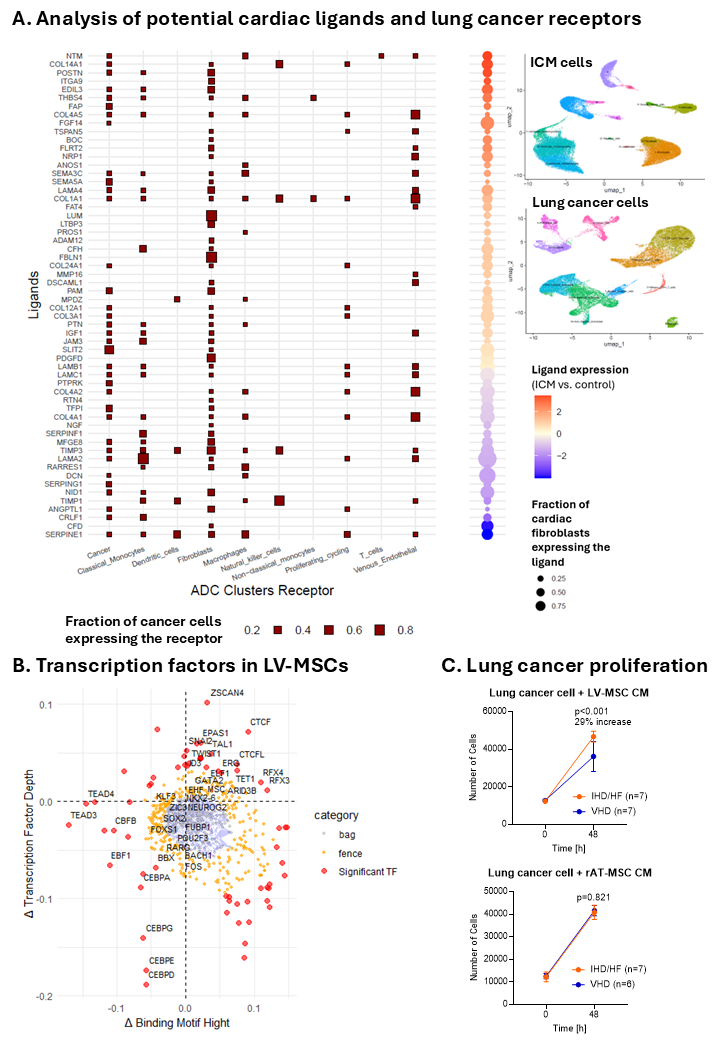
Methods & Results: Single-cell RNA sequencing data from lung cancer tumors, ischemic cardiomyopathy, and controls analyzed receptor-ligand interactions using the NicheNET ligand-receptor dataset. This way, we could predict which cardiac cells potentially send ligands to receptors on tumor cells. We identified cardiac fibroblasts and pericytes from ischemic hearts as potential sources of tumorigenic ligands, including periostin (Figure 1A).
Next, cMSC, including fibroblasts and pericytes, were isolated from 18 ischemic heart disease (IHD)/heart failure (HF) patients undergoing heart surgery and from 12 control donors undergoing valve repair. cMSC were derived from the LV, right atrium (rAT), or epicardial fat. We used an assay for transposase-accessible chromatin sequencing (ATAC-seq) with footprinting computational analysis and functional cancer cell proliferation assay to evaluate the pro-tumorigenic effects of cardiac MSCs, as well as the epigenetic programs governing those effects. Higher activity of chromatin remodeling and epigenetic modifying transcription factors (TFs) such as CTCF, CTCFL, and TET1 was observed, along with the activity of potentially tumorigenic TFs such as TWIST1, SNAI1, and HIF-2α in LV-MSCs. This implies that disease-activated cMSCs undergo chromatin remodeling for pro-angiogenic, pro-survival, and pro-cycling programs (Figure 1B). Furthermore, conditioned media from ischemic LV-MSC—but not rAT-MSC—induced a 29% increase in lung cancer cell proliferation (p<0.001, Figure 1C).
Conclusions: For the first time, we show that human cMSC from ischemic or failing hearts undergo epigenetic reprogramming and secrete factors that induce proliferation of lung cancer cells. A better understanding of this interaction could foster the development of preventive treatment for both heart diseases and cancer.
israelheart@ortra.com מייל לשאלות
