
Prevalence and long-term prognostic significance of advanced diastolic dysfunction among hospitalized patients referred for echocardiography
2Faculty of Medicine, Hebrew University of Jerusalem, Israel
3Azrieli Faculty of Medicine, Bar-Ilan University, Israel
4Sackler Faculty of Medicine, Tel Aviv University, Israel
Objectives: To describe the prevalence and predictors of advanced LVDD among hospitalized patients and its long-term (5-year) prognostic significance on all-cause mortality.
Methods: A retrospective observational study of consecutive non-selected hospitalized patients referred for echocardiography at a tertiary care medical center from October 2013 to February 2024. Diastolic function was classified into normal/LVDD grades I vs. advanced LVDD (grades II and III).
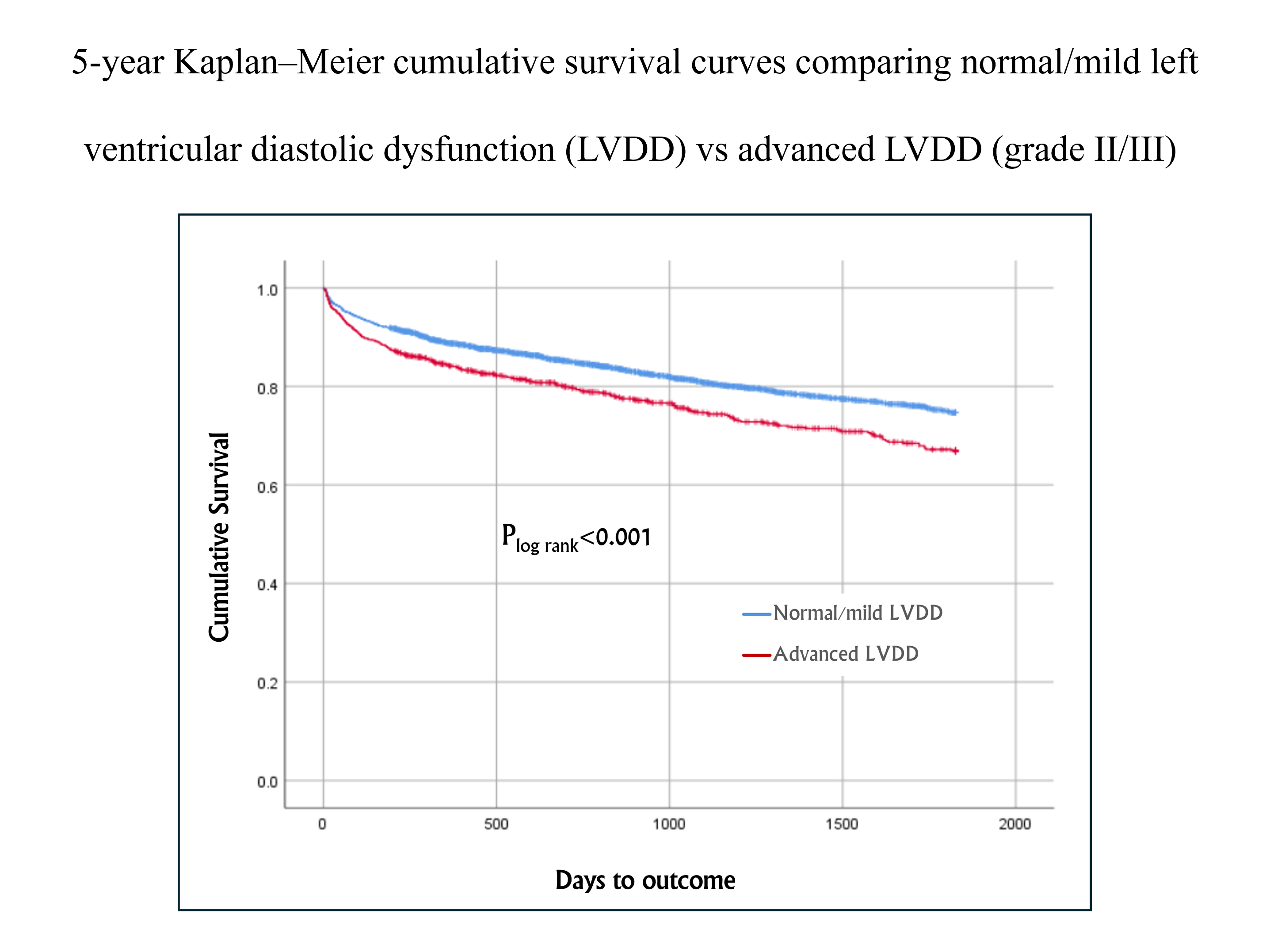
Results: 5,926 participants were included in the analysis, of whom 3,229 (54%) were men with a mean age of 66±2 years. These included 4,779 (81%) patients with normal/LVDD grade I and 1,147 (19%) with advanced LVDD. Compared to patients with normal/LVDD grade I, those with advanced LVDD were older, more likely to be men and had a higher burden of hypertension, diabetes mellitus, congestive heart failure, atrial fibrillation/flutter and renal failure, abnormal laboratory findings, worse echocardiogram parameters and longer hospital stay. Multivariate analysis revealed that advanced LVDD was independently associated with increasing age, male sex, significant aortic stenosis, hypertension and atrial fibrillation. Patients with advanced LVDD vs normal/LVDD grade I had higher 5-year all-cause mortality rates (plog-rank<0.001). Multivariate Cox proportional-hazards regression model revealed that advanced LVDD was associated with a 24% increase in the 5-year mortality rate (HR=1.236, 95% CI of 1.008-1.517, p=0.042).
Conclusion: Among hospitalized patients referred for echocardiography the prevalence of advanced LVDD was 19%, and was independently associated with age, male sex and the presence of multiple comorbidities. Moreover, advanced LVDD was identified as an independent predictor of long-term all-cause mortality. Advanced LVDD should be proactively diagnosed among admitted patients at risk for early therapy tailoring.
israelheart@ortra.com מייל לשאלות
