
Gender disparities in the prognosis of ST-segment elevation MI with normal Troponin on admission
2Kittner-Davidai Division of Cardiovascular Medicine and Surgery, Tzafon (Poriya) Medical Center, Israel
3Cardiovascular Medicine, Hillel Yaffe MC, Israel
4Cardiology Division, Galilee Medical Center, Israel
5Cardiology And Heart Disease, Bnai Zion medical Center, Israel
Introduction:ST-segment elevation myocardial infarction (STEMI) is less common in women, about 25-35%. However, mortality rates among women with MI are approximately 50% higher compared to men and remain about 20% higher even after adjusting for age. Our group has previously demonstrated that STEMI patients with normal troponin values on admission have improved long-term survival compared to those with elevated levels. This study aims to explore gender disparities within this unique patient population-STEMI patients with normal troponin levels on admission.
Methods:We utilized the Israeli Ministry of Health database ("KINERET") and obtained mortality data from the "Israeli Population Registry". This analysis included all patients admitted to the Cardiovascular Divisions at Tzafon Medical Center, Galilee Medical Center, Bnei-Zion Medical Center, and Hillel-Yaffe Medical Center between 2016-2024 with a diagnosis of STEMI. Troponin cut-off levels were determined based on ESC criteria for myocardial infarction (52ng/ml for Troponin-T and 64ng/ml for Troponin-I).
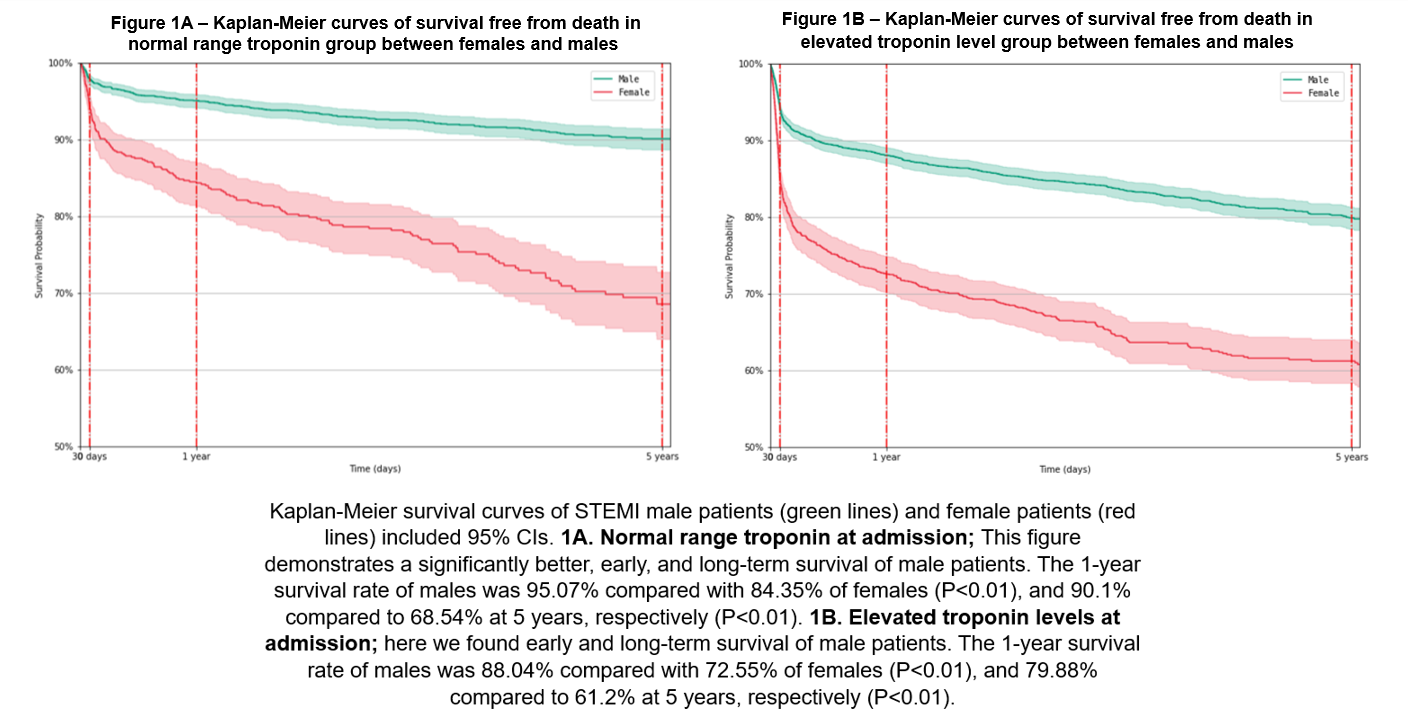
Results:A total of 8,394 patients (76% male, mean age 68.3 years) were included in this study. Elevated initial troponin levels were observed in 63.5% (n=5,330) of the patients, with a statistically significant male predominance (73.9%; p<0.01). Initial troponin levels on admission had a significant impact on survival, with patients presenting with normal troponin levels demonstrating better outcomes (p<0.01). Among STEMI patients with normal troponin levels on admission, 5-year survival rates were significantly higher in men compared to women (90.1% vs. 68.5%, p<0.01, Figure 1A). In patients with elevated troponin levels on admission, the survival differences between men and women were less pronounced (79.88% vs. 61.2%, p<0.01, Figure 1B).
Conclusion:Our study highlights significant gender disparities in the prognosis of STEMI patients, with higher mortality rates observed in women. These disparities are particularly pronounced in patients with normal troponin levels on admission, underscoring the need for further investigation and tailored management strategies in this subgroup.
israelheart@ortra.com מייל לשאלות
