
A Decade of Progress: Decreasing Mortality in Octogenarians with Heart Failure
2Health systems management, Faculty of health sciences, Ariel University, Israel
3Israel Hospital division, Clalit Health Services, Israel
Background: Octogenarians (aged ≥80) represent a significant subpopulation of heart failure (HF) patients, yet they remain underrepresented in clinical trials. This study aims to evaluate trends in mortality among octogenarians with HF over a period spanning more than a decade.
Methods: Retrospective analysis of HF patients treated during 2009-2024 in a single tertiary center. Kaplan-Meier survival analysis and Cox proportional hazards regression models were applied, stratifying patients into octogenarians and non-octogenarians, and further divided by time period (before and after June 2016, median diagnosis date). Sensitivity analyses were performed to ensure the robustness of the findings.
Results: The final cohort included 32,902 patients, median age 72 years (IQR 64-82), 19,167 (58%) were male and 11,013 (33%) octogenarians. Over a median follow-up duration of 5 years (IQR 1-7), 18,558 (56%) patients died. Kaplan-Meier analysis revealed a 5-year cumulative probability of death of 81.5%±0.8% in octogenarians vs 69%±0.9% in non-octogenarians (p <.001). During the study period treatment strategies evolved significantly incorporating more sodium glucose cotransporter inhibitors-2 (1.4% vs 12%) and mineralocorticoid receptor antagonist (6% vs 26%). Adjusted model accounting for guideline-directed medical therapy and other established mortality predictors, the mortality risk associated with older age was significantly time-period dependent. During the early period, octogenarians had a 2.5-fold increased risk of death (HR 2.53, 95% CI 2.4-2.7, p < .001), compared with a substantially lower risk later (HR 1.93, 95% CI 1.8-2.0, p < .001; p for interaction = .002) (Figure).
Conclusions: While advanced age remains a strong predictor of mortality in HF, we demonstrate a significant improvement in survival among octogenarians in recent years, coinciding with the adoption of new therapeutic agents. This highlights the importance of contemporary HF management in improving survival, even in the elderly.
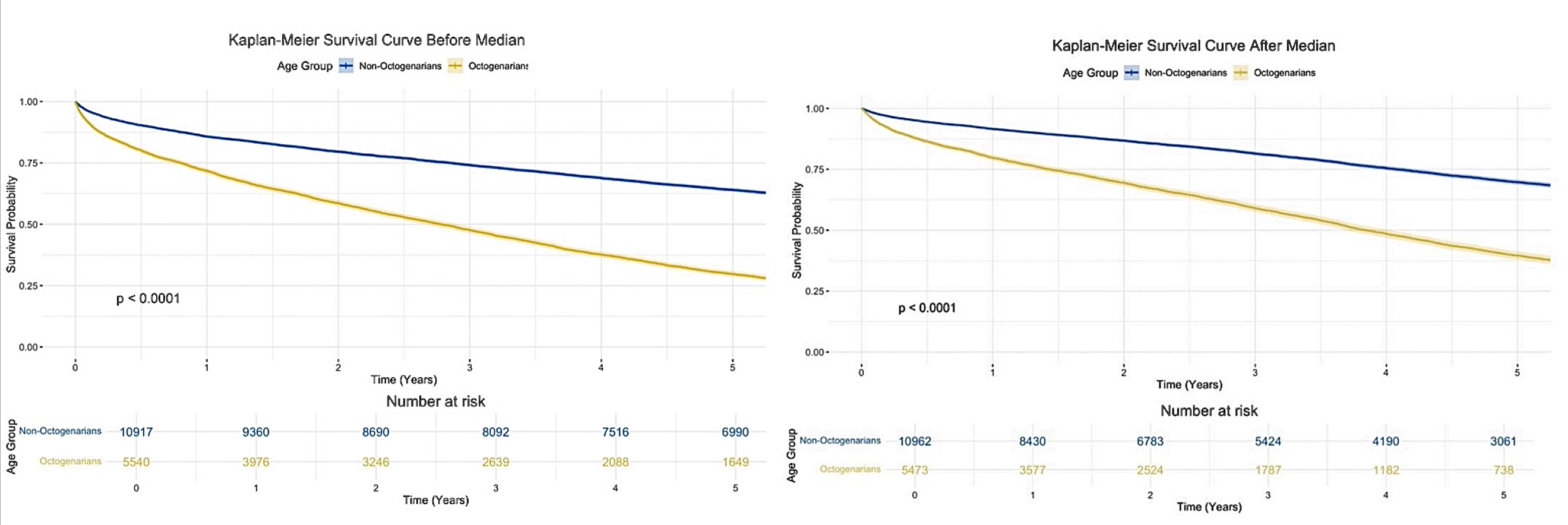
Figure: Adjusted Kaplan-Meier Curves Comparing Early vs Late Periods
israelheart@ortra.com מייל לשאלות
