
Calcium Channel Blockers Use and Outcome of Patient with Heart Failure
2Health Systems Management, Faculty of Health Sciences, Ariel University, Israel
3Israel Hospital Division, Clalit Health Services, Israel
4The Adelson School of Medicine, Ariel University, Israel
Background: The past decade has seen a `renaissance` in pharmacological management of heart failure (HF). Though hypertension (HTN) is common among HF patients, the role of calcium channel blockers (CCB) remains unclear. This study evaluated the association of CCB use with survival among HF patients.
Methods: This retrospective cohort included 21,809 HF patients treated between January 2014 and August 2024 in a tertiary center. Patients were categorized by CCB use, and inverse probability treatment weighting (IPTW) adjusted baseline differences. One- and two-year survival were assessed using binary logistic regression, and overall survival analyzed with Kaplan-Meier methods.
Results: The cohort included 6,481 CCB users and 15,328 non-users (median age 74 years [IQR 76 ± 12 vs. 73 ± 14, p < 0.01]). Baseline characteristics were significantly different between groups. Over a median follow-up of 3.6±3 years, 10,168 (46%) patients died. Following IPTW, the pseudo-population consisted of 23,073 patients with a median age of 73±11; 11,664 (50.5%) were in the CCB group with balanced baseline characteristics. After IPTW, CCB use demonstrated no significant impact on overall survival (HR 1.01, 95% CI 0.97–1.05, p = 0.95). Similar 1- and 2-year mortality rates were noted (p > 0.4 for all). Comparative analysis of other antihypertensive agents revealed that alpha-blockers were associated with 12% increased mortality (95% CI 1.01–1.24, p = 0.04), while renin-angiotensin-aldosterone system inhibitors (RAASi) were associated with 11% reduced mortality (95% CI 0.83–0.95, p = 0.01) (Figure). Subgroup analyses showed no significant interaction between CCB use and comorbidities, except in patients with GFR < 30 ml/min, where CCB was associated with better survival (HR 0.85, 95% CI 0.76–0.95, p < 0.01).
Conclusion: This study shows that CCB are safe in hypertensive patients with HF. Randomized clinical trials are necessary to confirm these findings. 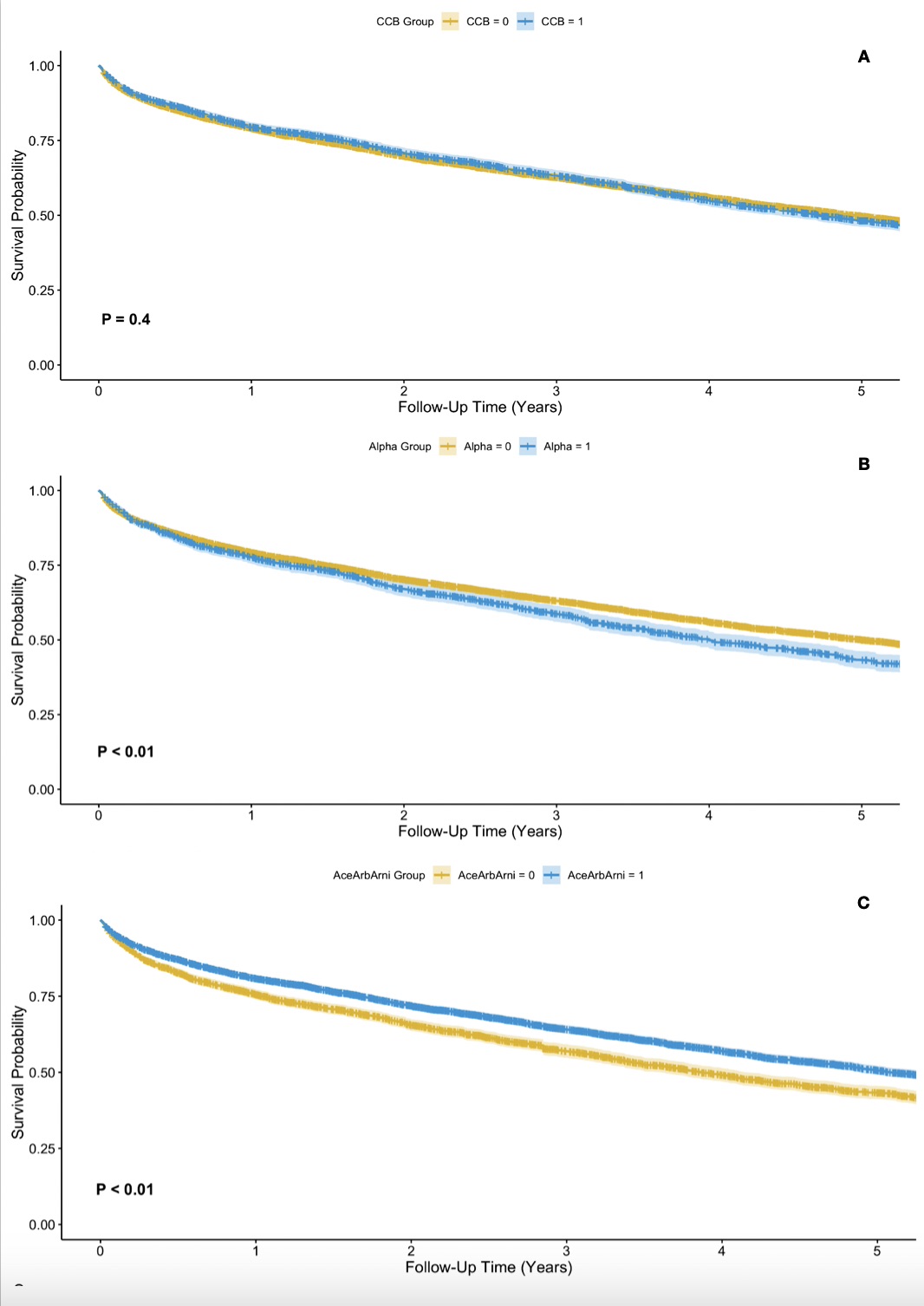
Figure: Adjusted IPTW Kaplan-Meier for CCB(A), Alpha Blockers(B) and RAASi(C) intake
israelheart@ortra.com מייל לשאלות
