
Sustained-Release Particles Delivering Potent MMP9 Inhibitor as a Novel Treatment Post Myocardial Infarction: Testing the Applicability of Intracoronary Administration
2Regenerative Medicine & Stem Cell Research Center, Ben-Gurion University of the Negev, Israel
3Department of Biotechnology Engineering, Ben-Gurion University of the Negev, Israel
Background: Myocardial infarction (MI) is a leading cause of cardiac dysfunction globally, often leading to left ventricular (LV) remodeling which further increases the risk of heart failure progression. Matrix metalloproteinase-9 (MMP-9) plays a critical role in this process, with its activity surpassing its inhibitor TIMP2 during the first week post-MI, leading to excessive extracellular matrix degradation. To address this, we developed C9-HBP3-AlgS microparticles, a sustained-release system that inhibits MMP-9. While direct myocardial injection of these particles in post-MI mice was able to potently inhibit LV remodeling, this mode of application lacks clinical feasibility.
Objective: This study explores intracoronary administration of C9-HBP3-AlgS particles as a potential strategy to deliver anti-remodeling therapy to the ischemic myocardium. We hypothesize that ischemia-induced endothelial dysfunction enhances myocardial uptake of these particles, offering promising clinical applicability.
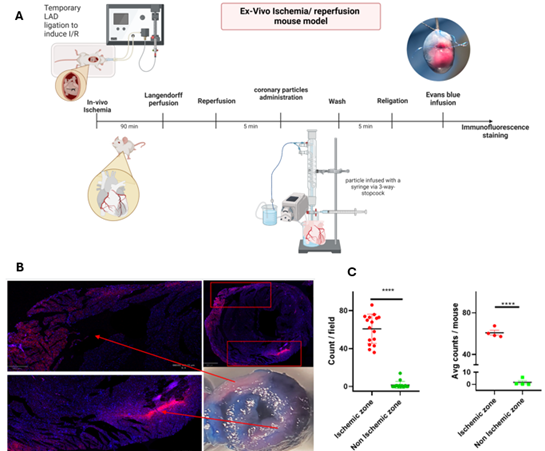
Methods & Results: To validate detection of C9-HBP3-AlgS particles within the myocardium, we first injected the particles directly into mouse myocardium and confirmed their presence using immunofluorescent staining with a HIS tag-specific primary antibody and Alexa Fluor 647 secondary antibody. Thereafter, adult mice (n=4) underwent 90 minutes of in vivo cardiac ischemia by left coronary artery ligation, followed by ex vivo reperfusion and intracoronary injection of the particles. Subsequent Evans blue dye differentiated ischemic and non-ischemic myocardial regions (Fig. 1A). Immunofluorescent imaging demonstrated significant particle accumulation in ischemic regions, while non-ischemic areas displayed only nuclear DAPI staining (Fig. 1B). Quantitative analysis indicated a highly significant enrichment of particles in ischemic regions (Fig. 1C).
Conclusion: C9-HBP3-AlgS particles effectively cross the ischemic endothelial barrier, accumulate in damaged myocardium, and therefore have the potential to alleviate post-MI remodeling. These findings highlight the potential of this novel therapeutic approach to improve cardiac repair in patients with acute MI.
israelheart@ortra.com מייל לשאלות
