
Gender-Specific Mortality Benefits of Renin–Angiotensin–Aldosterone System Inhibitors in Heart Failure Patients
2Health Systems Management, Faculty of Health Sciences, Ariel University, Israel
3Israel Hospital Division, Clalit Health Services, Israel
Background: Renin–angiotensin–aldosterone system inhibitors (RAASi) are a cornerstone in heart failure (HF) management, consistently demonstrating mortality benefits. However, the differential impact of RAASi therapy on mortality between women and men remains underexplored. This study investigates gender-specific outcomes associated with RAASi use in HF patients.
Methods: This retrospective cohort study included HF patients treated between January 2014 and August 2024 at a single tertiary center. Patients were categorized by gender and RAASi use. The primary outcome was all-cause mortality. Cox proportional hazards models were applied to assess mortality risk, adjusted for age and established comorbidities. Inverse probability treatment weighting (IPTW) was used to account for confounders.
Results: The cohort included 21,809 HF patients (median age 74±14 years), of whom 9,040 (41%) were women and 12,482 (57%) were RAASi users. During a median follow-up of 3.5±3 years, 10,168 (46%) patients died. RAASi use was associated with a significant reduction in all-cause mortality in both men (HR 0.77, 95% CI 0.71–0.83, p < 0.001) and women, though the effect was less pronounced in women (HR 0.87, 95% CI 0.81–0.95, p < 0.01; p interaction < 0.01). In the IPTW pseudo-population, which included 10,590 women and 12,722 men with equal proportions of RAASi users (50% in each group) and balanced covariates, including HTN, the trend remained consistent. Women experienced a less pronounced reduction (HR 0.87, 95% CI 0.79–0.95, p < 0.01) compared to men (HR 0.77, 95% CI 0.71–0.83, p < 0.01) (Figure).
Conclusions: RAASi therapy significantly reduces all-cause mortality in HF patients, with men deriving a greater benefit than women. These findings highlight the importance of gender-specific considerations in HF management.
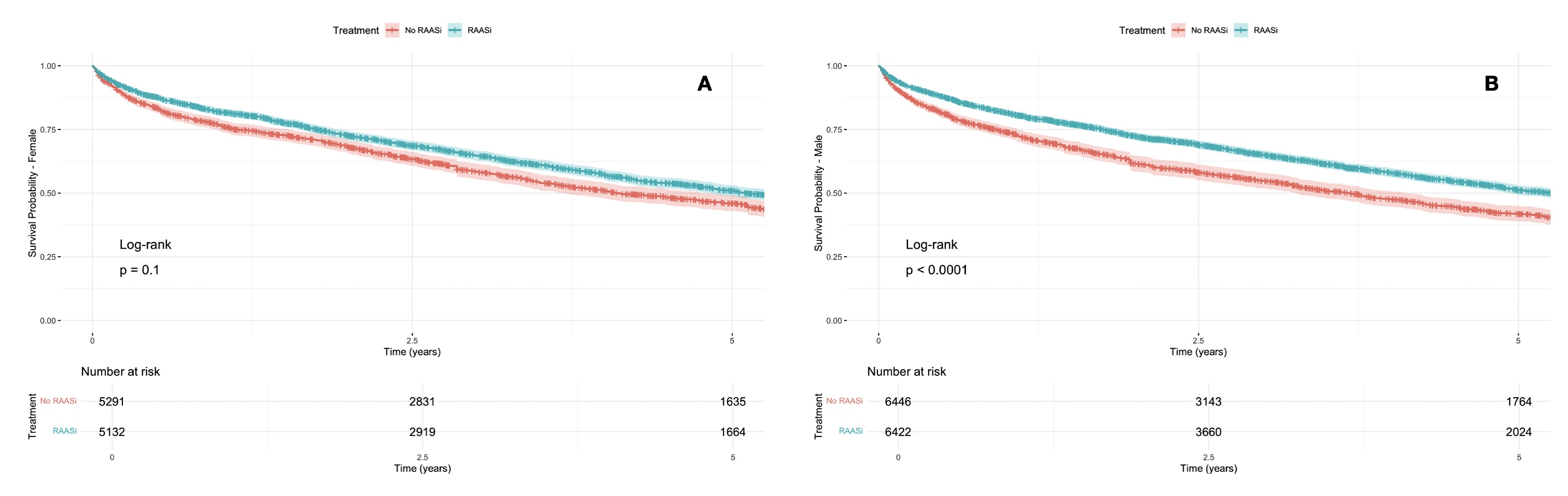
Figure: Inverse probability of treatment weighting based adjusted Kaplan Meier curves comparing RAASi use between women (A) and men (B).
israelheart@ortra.com מייל לשאלות
