
Higher burden of cancer in patients with cardiovascular diseases
2Lev Leviev Cardiovascular and Thoracic Center, Sheba Medical Center, Tel Hashomer, Israel
3Jesselson Integrated Heart Center, The Eisenberg R&D Authority, Shaare Zedek Medical Center, The Hebrew University, Jerusalem, Israel
4School of Medicine, Tel Aviv University, Israel
Introduction: Cardiovascular diseases (CVD) are associated with an increased risk of cancer. However, the association between CVD and second-primary cancer, cancer-related hospitalizations, or death wasn’t described.
Methods: We analyzed data from 109,204 adults, free of cancer at baseline, with valid echocardiography examination between 2000-2024. Cancer, CVD, hospitalization, and mortality data were obtained from Israel`s National Registries and institutional records. We used ICD9 codes to identify 2nd primary cancer. To avoid the detection of asymptomatic cancer, we implicated a 3-month blanking period at the start of the follow-up. Then, we used Cox regression and Poisson regression to assess the link between CVD and cancer incidence, hospitalizations, and death and to adjust for age, sex, BMI, smoking, and eGFR.
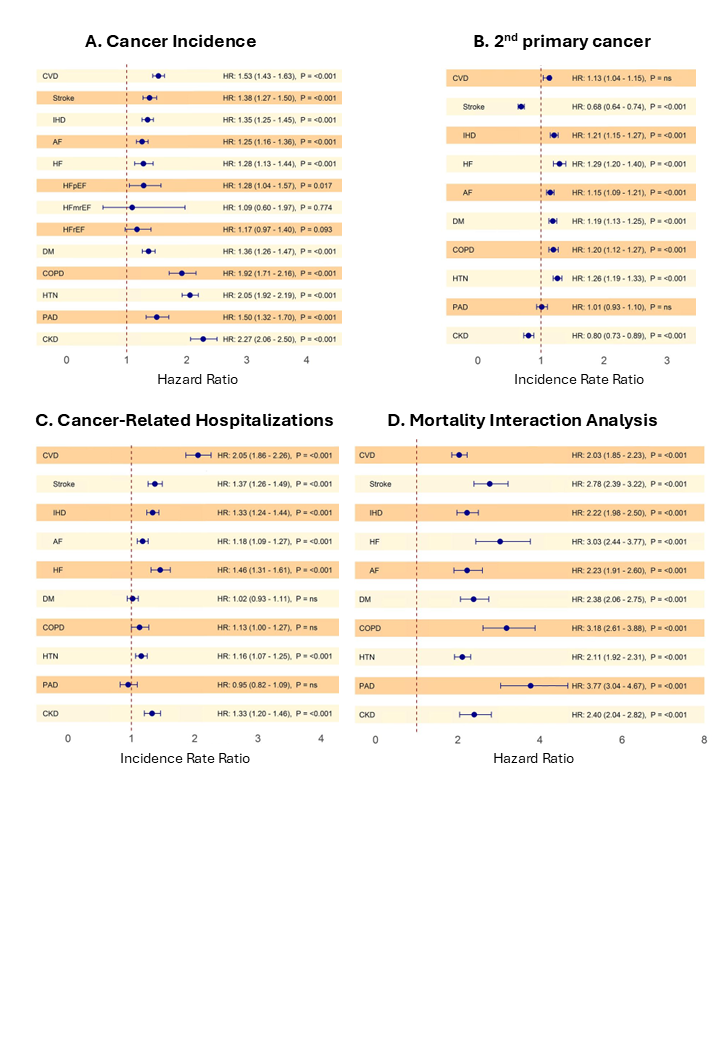
Results: During a median follow-up of 6.0 ± 4.4 years, there were 62,898 (58%) cases of CVD, and 4441 (4%) patients developed cancer; of them, 192 patients developed 2nd primary cancer. CVD was associated with an increased multivariable-adjusted risk of cancer (HR=1.53, 95%CI: 1.43-1.63, Figure 1A). CVD was also associated with a 13% higher incidence of second primary cancer (IRR=1.13, 95%CI: 1.04-1.15, Figure 1B), which is the development of another cancer type. Furthermore, CVD was also associated with a 2-fold increase in cancer-related hospitalizations in patients with cancer (1.64 vs 3.83 hospitalizations per year, IRR=2.05, 95%CI: 1.86-2.26, Figure 1C). Finally, we used interaction analysis to assess the link between CVD, cancer, and mortality. We found a significant interaction between CVD and cancer, indicating that the increased risk of death associated with cancer twice fold in patients with CVD (HR=2.05, 95%CI: 1.85-2.23, Figure 1D).
Conclusion: CVD, specifically atherosclerotic CVD and heart failure are associated with an increased risk of cancer and a higher cancer burden and mortality. Understanding this association could promote prevention, early diagnosis, and better treatment of cancer in patients with CVD.
israelheart@ortra.com מייל לשאלות
