
Hypertension and Heart Failure: Uncovering Gender Differences in Mortality Outcomes
2Health Systems Management, Faculty of Health Sciences, Ariel University, Israel
3Israel Hospital Division, Clalit Health Services, Israel
4Internal Medicine D, Sheba medical Center, Israel
5Sackler Faculty of Medicine, University of Tel Aviv, Israel
Background: Risk factors in heart failure (HF) patients often differ between genders, yet their effect and outcomes in women remain underexplored. Hypertension (HTN), a common modifiable comorbidity in HF, may have varied prognostic effects in men and women. This study aimed to investigate gender-specific outcomes associated with HTN in HF patients.
Methods: A retrospective analysis of HF patients treated between 2009 and 2024 at a single tertiary center was performed. The cohort was analyzed using Kaplan-Meier survival analysis, Cox, and binary proportional hazards regression models, stratified by established HF comorbidities. Interaction analyses assessed the influence of HTN and gender on mortality risk. Sensitivity analyses based on HF subtype were also conducted.
Results: The final cohort included 32,902 patients (median age 72 years [IQR 64–82]),with 22,044 (67%) diagnosed with HTN and 15,135 (46%) female. Over a median follow-up of 5 years (IQR 1–7), 18,558 (56%) patients died. The impact of HTN was significantly gender-specific, with a robust association among women (HR 1.17, 95% CI 1.07–1.29, p < 0.01), however not in men (HR 0.98, 95% CI 0.91–1.06, p = 0.64, p for interaction = 0.015) when assessed for all-cause mortality. This trend was consistent across 1-year and 2-year mortality analyses. When stratified by HF subtype, in HF with preserved ejection fraction (HFpEF) the impact of HTN was further gender specific, as women with HTN had worse outcomes (HR 1.00, 95% CI 0.89–1.12, p = 0.98, p-interaction <0.01) compared to men with HTN (HR 0.83, 95% CI 0.73–0.94, p < 0.01).
Conclusions: HTN is associated with increased mortality risk in women with HF, particularly in HFpEF. These findings underscore the importance of considering gender-specific factors in the management of comorbidities among heart failure patients.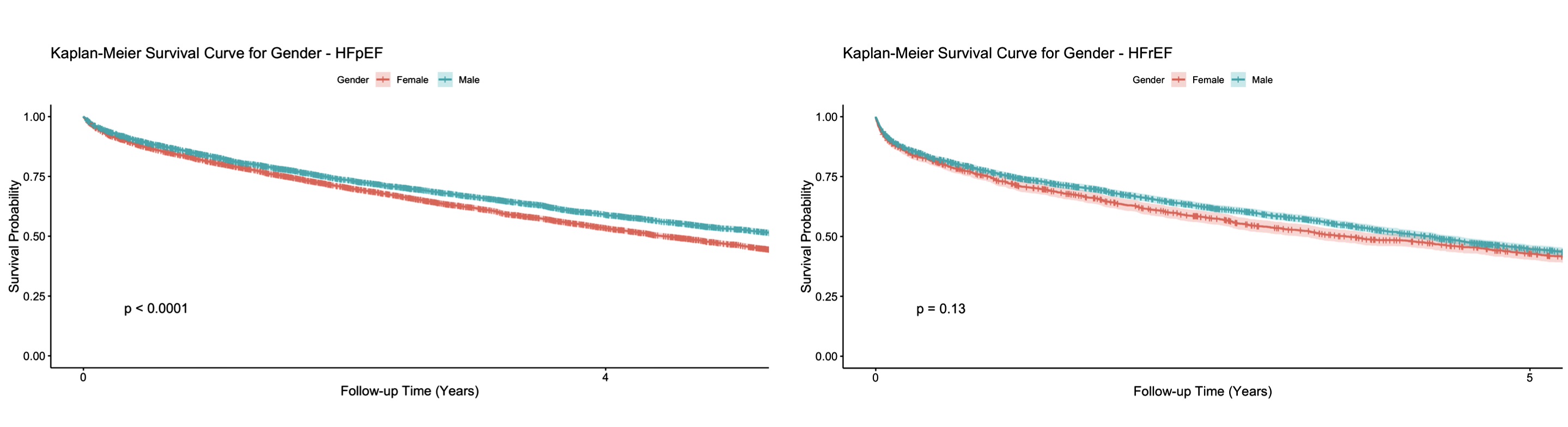
Figure: Kaplan-Meier comparing men and women with HTN and HF subtype
israelheart@ortra.com מייל לשאלות
