
Prognostic value of pulmonary vascular resistance and right ventricular function in patients after heart transplantation
2Faculty of Medicine & Health Sciences, Tel-Aviv University, Israel
Introduction
Although pretransplant elevated pulmonary vascular resistance (PVR) is a relative contraindication for HT, patients are often transplanted albeit their elevated PVR. Furthermore, the relationship between immediate posttransplant right ventricular (RV) function and long-term outcomes in this patient population has not been established. This study aims to examine the relationship between pretransplant PVR and posttransplant hemodynamic and clinical outcomes, with a focus on RV function.
Materials and Methods
In this retrospective cohort analysis, HT recipients in the Rabin medical center (1992-2023) were stratified according to their pretransplant PVR. Hemodynamic parameters before and after HT were compared between the groups. Kaplan-Meier survival analysis and multivariable regression models (adjusted for age and sex) assessed mortality risk. Logistic regression explored the relationship between RV function immediately after HT and long-term RV function.
Preliminary Results and Discussion
Of 102 recipients, 96 had available pretransplant PVR measurements. Patients with PVR>3.5 Wood units were more likely to have had prior left ventricular assist device (LVAD) support (p=0.02), non-ischemic HF etiology (p=0.009), and pretransplant inotrope therapy (p=0.03). Although patients with pretransplant elevated PVR had higher pulmonary and capillary wedge pressures at one-week post-transplant, (p<0.001 and p=0.035, respectively), these differences were not statistically significant at one month (p=0.1, p=0.34) or six months posttransplant (p=0.16, p=0.73). After a median follow-up of 27 months, there was no significant mortality difference between the 2 groups (HR 1.47[0.69-3.1]).
Conclusion
These preliminary results suggest no significant survival difference in HT recipients with pretransplant elevated PVR compared to those with pretransplant lower PVR. Furthermore, early post-transplant hemodynamic differences between patients with high and low PVR diminished over time. These results raise the possibility that selected patients with pretransplant elevated PVR may still achieve comparable long-term outcomes, and therefore they should not necessarily be excluded from receiving a HT.
To note: preliminary results, data gathering is still ongoing.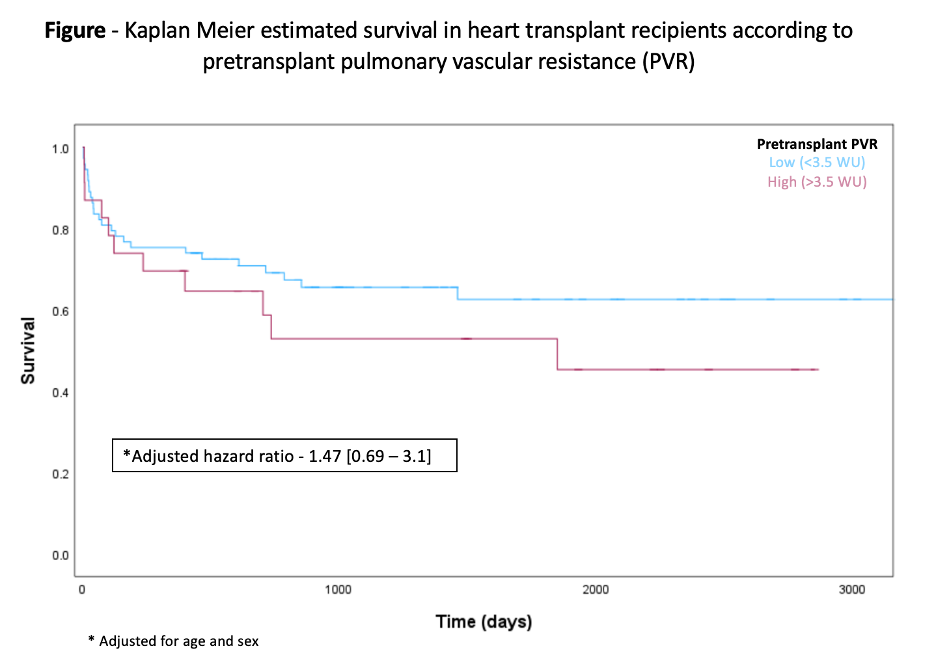
israelheart@ortra.com מייל לשאלות
