
Impact of Pre-Procedural Rhythm Status on Atrial Fibrillation Recurrence and Outcomes Post-PVI: Insights from a National Multicenter Ablation Registry
2Cardiological ICU, Baruch Padeh Medical Center, Israel
3Cardiology, Shaare Zedek Medical Center, Israel
4Cardiology, Soroka University Medical Center,, Israel
5Cardiology, Hadassah University Medical Center,, Israel
6Cardiology, Meir Medical Center, Israel
7Cardiology, Assuta Ashdod University Hospital, Israel
8Cardiology, Rambam Health Care Campus, Israel
Background: Pulmonary vein isolation (PVI) is increasingly recognized as a cornerstone treatment for paroxysmal and persistent atrial fibrillation (AF). Despite its growing usage, a notable number of patients experience arrhythmia recurrence.
Purpose: To determine whether pre-procedural rhythm status impacts recurrence rates and clinical outcomes in AF patients treated with PVI.
Methods: Data were drawn from the Israeli Catheter Ablation Registry (ICAR), a prospective, multicenter registry of AF ablations conducted at 14 centers between January 2019 and December 2021. Patients were divided into two groups based on rhythm at the time of ablation: sinus rhythm and non-sinus rhythm. Baseline characteristics, procedural details, and follow-up data, including AF recurrence and hospitalization rates were prospectively collected. The primary outcome was post-blanking AF recurrence within a 2-year follow-up period.
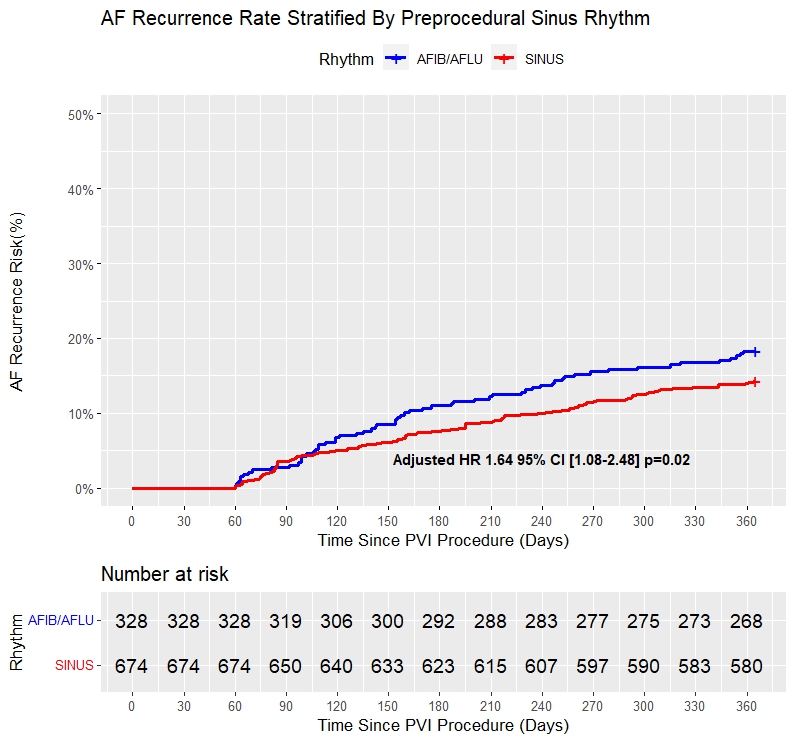
Results: Among 1002 patients, 674 (67.3%) were in sinus rhythm and 328 (32.7%) in non-sinus rhythm at the time of PVI. Patients in sinus rhythm were younger (63.2 ±11.8 vs. 65.7 ±9.9 years, p<0.01), had higher left ventricular ejection fraction (LVEF) (56.1±9.2 vs. 51.0 ±12.1, p<0.01), and more commonly had paroxysmal AF (83.0% vs. 29.1%, p<0.01). The sinus rhythm group experienced significantly lower AF recurrence rates at 2 years (18.7% vs. 24.7%, p=0.03) and fewer hospitalizations (15.0% vs. 23.5%, p=0.001). A Multivariable COX proportional hazard regression model showed that non-sinus rhythm at PVI was independently associated with higher 1-year AF recurrence rates (HR 1.64, 95% CI [1.08-2.48], p=0.02).
Conclusion: Patients in sinus rhythm at the time of PVI exhibited lower AF recurrence rates and reduced hospitalization. These findings support a treatment approach focused on achieving and maintaining sinus rhythm before PVI to optimize outcomes in AF patients.
israelheart@ortra.com מייל לשאלות
