
Prediction of Significant Coronary Artery Disease (Positive SPECT Nuclear Heart Mapping) from Stress Electrocardiogram Using Deep Learning
2The Olga and Lev Leviev Heart Center, Sheba Medical Center, Israel
Background: Stress Electrocardiogram (ECG) is a widely used, non-invasive tool for evaluating myocardial ischemia. However, its diagnostic accuracy remains suboptimal, with sensitivity ranging from 50%-75% and specificity between 68%-87%. Deep learning offers the potential to enhance diagnostic performance and automate ECG interpretation, thus providing improved accuracy and scalability.
Methods: Patients who underwent stress 12-lead ECG tests (Bruce) immediately followed by a Single Photon Emission Computed Tomography (SPECT) imaging at Sheba Medical Center were identified between 2017 to 2024. Dataset contains 3,790 distinct patients (35.8% females, ages 21-90, median=63) and 6,571 ECG recordings with diagnostic labels for myocardial ischemia (≥5% ischemia in SPECT-imaging defined as positive). ECG signals preprocessing included a 1-30 Hz bandpass filter, decimation to 100 Hz, and R-R-R segmentation. A Variational Autoencoder (VAE) was trained on 42,622 stress ECG recordings to create 48-dimensional embeddings per segment. These embeddings were fed into a Transformer-based model to predict ischemia.
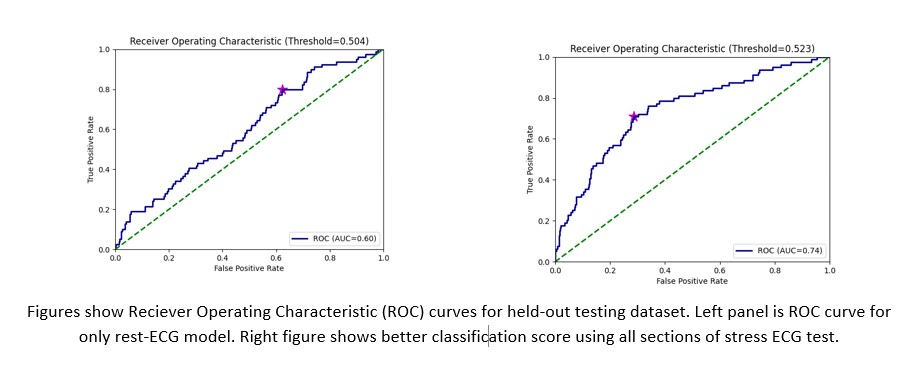
Results: Out of a total of 762 cases in the hold-out test set, 79 were classified as positive. The model achieved a performance of 0.742 AUROC, with 71.1% weighted accuracy, 70.9% sensitivity, and 71.3% specificity on the test set. In contrast, when using only the rest phase of the ECG, the classification performance decreased significantly, yielding an AUROC of 0.598, 58.6% weighted accuracy, 79.7% sensitivity, and 37.6% specificity.
Conclusions: Deep-learning models demonstrated acceptable performance in detecting ischemia, with stress ECG outperforming rest ECG. This ongoing study shows promise, and improvements in data cleaning and labeling are expected to enhance results. While the findings are preliminary, this approach has the potential to impact cardiology by refining workflows, reducing false positives, and offering a scalable method for detecting ischemia. Additional work is needed to fully realize its potential in improving CAD diagnostics.
israelheart@ortra.com מייל לשאלות
