
Mitral Annular Calcium Score as a Non-Invasive Marker for Mitral Valve Dysfunction Severity
Background: Computed tomography-based aortic valve calcium scoring is well-documented for its correlation with echocardiographic indices of aortic stenosis severity, serving as a validated supplemental marker. In contrast, the correlation between the mitral annular calcium score and echocardiographic indicators of mitral valve (MV) dysfunction severity remains unclear.
Objective: This study aims to evaluate whether the mitral annular calcium score can act as a non-invasive indicator of MV dysfunction severity and its correlation with both mean and peak mitral pressure gradients (MPG).
Methods: A retrospective analysis was conducted on 650 patients who underwent cardiac CT and subsequent echocardiographic evaluation of the mitral valve within a nine-month period. Detailed transthoracic echocardiography (TTE) data and cardiac CT scans were analyzed. The mitral annular calcium score was quantified using the Agatston method, examining its relationship with mean MPG, peak MPG, and mitral valve area (MVA).
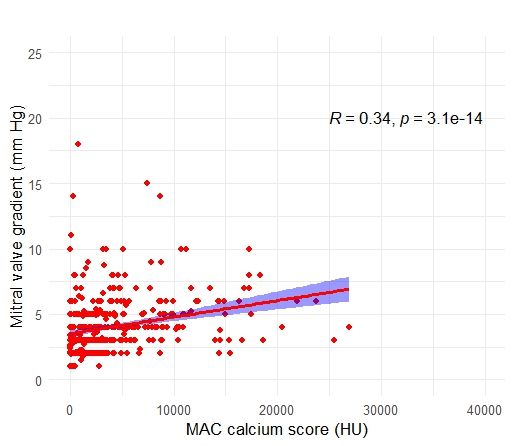
Results: The cohort, with a mean age of 80.1 ± 6.2 years and comprising 59% females, had a median mitral annular calcium score of 1757 (interquartile range: 310-4130). Significant correlations were found between higher mitral annular calcium scores and increased mean MPG (P < 0.001). Spearman correlation analysis further demonstrated that the mitral calcium score is a predictive factor for elevated peak MPG (r = 0.31, P < 0.001) and mean MPG (r = 0.36, P < 0.001).
Conclusion: Our results suggest that the mitral annular calcium score is an effective quantitative tool for assessing the severity of MV dysfunction. Higher scores correlate with increased MPGs, indicating the potential of this scoring system as a complementary diagnostic tool in evaluating severe MV dysfunction.
israelheart@ortra.com מייל לשאלות
