Developmental and Cognitive Determinants of Speech-in-Noise Perception in School-Age Children: Effects of Noise Type and Lexical Availability
Purpose: Understanding speech in noise (SiN) requires the integration of auditory, cognitive, and linguistic processes. Examining these mechanisms in children is important because successful listening in noisy environments underpins everyday communication and classroom learning, yet SiN abilities continue to develop throughout childhood. This study examined how working memory (WM) load, listening condition, lexical availability, age, and episodic memory (EM) contribute to SiN perception in school-age children.
Method: Sixty-two typically developing children aged 5-13 completed an auditory n-back task manipulating WM load (1-/2-back), listening condition (quiet, speech-shaped noise, four-talker babble), and lexical availability (high-/low-frequency words, pseudo-words), with SiN indexed by d′. An EM recognition task followed, and linear mixed-effects models tested predictors of SiN performance.
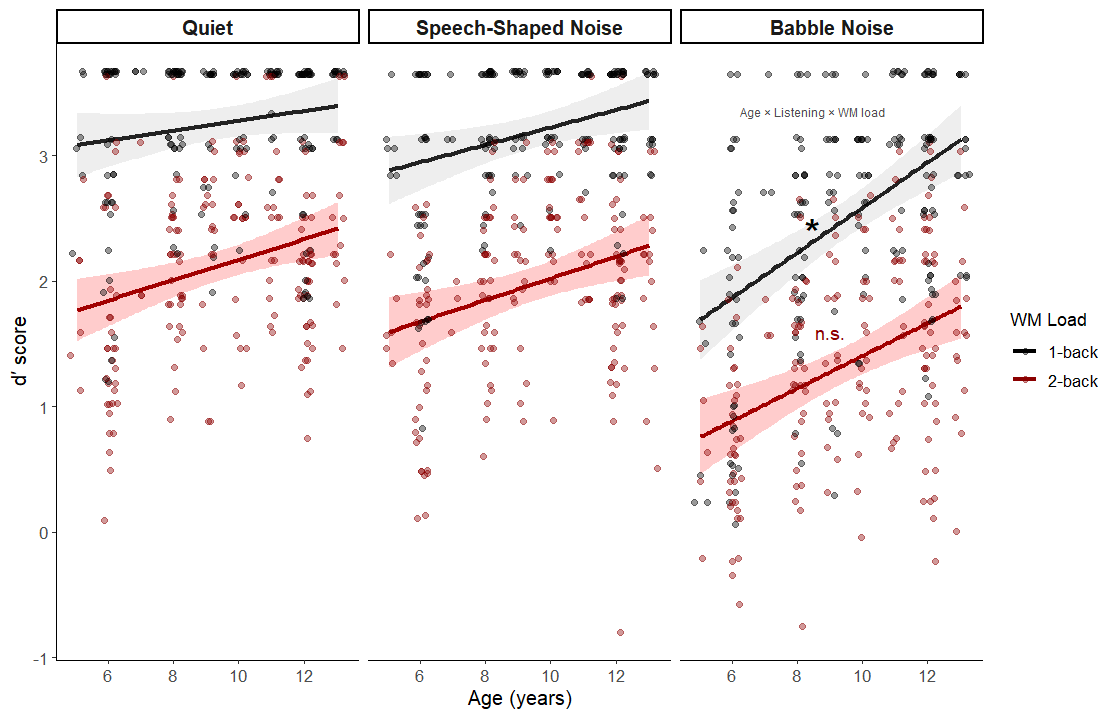
Results: SiN performance improved with age and declined under higher WM load, particularly in four-talker babble noise. Pseudo-words were recognized less accurately than real words. A significant interaction among WM load, listening condition, and age revealed that the detrimental effect of babble noise was amplified under high WM load and was greatest in younger children. EM performance also improved with age and was negatively affected by noise. An age-dependent lexical effect emerged, with high-frequency word advantage primarily in older children. Better EM predicted better SiN performance and this relationship weakened with age.
Conclusions: Children’s SiN perception reflects dynamic interactions among auditory, cognitive, and linguistic factors. In younger children, WM and EM mainly predict SiN perception, whereas older children increasingly rely on well-established lexical knowledge, indicating a developmental shift toward greater reliance on long-term linguistic knowledge with age.