Auditory Rhythm Modulates Vestibulo-ocular Reflex Plasticity
2Otolaryngology Head and neck surgery, Sheba Medical Center, Israel
3Department of Physical Therapy, Faculty of Social Welfare & Health Sciences, University of Haifa, Israel
Objective: To determine whether rhythmic auditory stimulation modulates gain adaptation during incremental vestibulo-ocular reflex training compared with silence and whether music provides additional benefit beyond a metronome.
Study Design: Randomized crossover study.
Setting: Single-center laboratory study.
Methods: Twelve healthy adults aged 28 to 40 years completed 3 sessions in randomized order, each separated by at least 48 hours. Each session included 15 minutes of active incremental vestibulo-ocular reflex adaptation training under 1 of 3 auditory conditions: silence, metronome, or self-selected rhythmic music. Active and Passive vestibulo-ocular reflex gains were measured with video head impulse testing before and after each session. During auditory sessions, head impulses were synchronized to the beat. The primary outcome was change in active and passive horizontal gain from pretraining to posttraining. Secondary outcomes included difficulty, ease of synchronization, and dizziness.
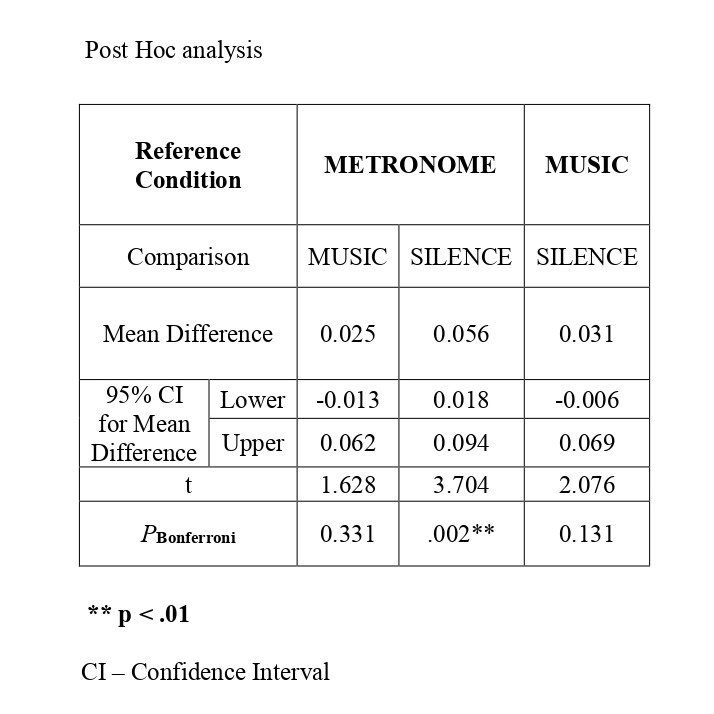
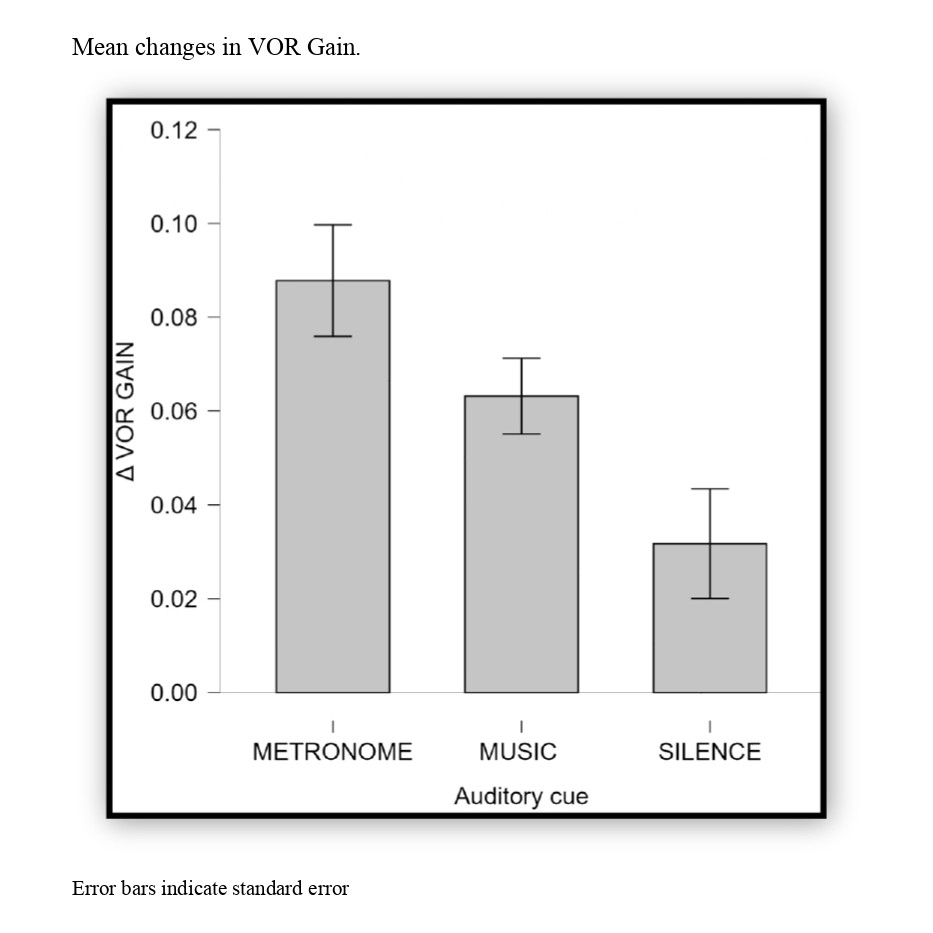
Results: Active vestibulo-ocular reflex gain increased more with auditory cues. Mean change was 8.8% with metronome, 6.3% with music, and 3.2% with silence. Metronome training produced a significantly larger gain increase than silence (mean difference, 0.056; 95% confidence interval, 0.018-0.094; P = .002). Music produced an intermediate gain increase that did not differ from metronome or silence. No between-condition differences were observed for passive gain change. Music was rated as less difficult than silence, while dizziness ratings were similar across conditions.
Conclusion: Rhythmic auditory stimulation, particularly a metronome beat, enhanced active vestibulo-ocular reflex gain adaptation. These findings suggest that auditory rhythm can serve as a cross-modal cue for vestibulo-ocular plasticity, linking auditory stimulation to vestibular adaptation.