Improving Cross-Plane Consistency in Accelerated MRI Using Sequential 2D Expert Networks
2The Manuel and Raquel Klachky Chair of Image Processing, Tel-Aviv University, Israel
3Diagnostic Imaging, affiliated with Gray School of Medicine, Tel-Aviv University, Sheba Medical Center, Israel
Background: Accelerated magnetic resonance imaging (MRI) substantially reduces scan time but degrades image quality through aliasing and resolution loss. Critically, this degradation is direction-dependent: image quality varies across sagittal, axial, and coronal planes. Since radiologists routinely scroll through slices and switch between planes when interpreting three-dimensional (3D) anatomy, inconsistent quality across planes can compromise diagnostic confidence. Existing deep learning reconstruction methods are optimized for global image metrics and do not explicitly enforce consistency across anatomical planes.
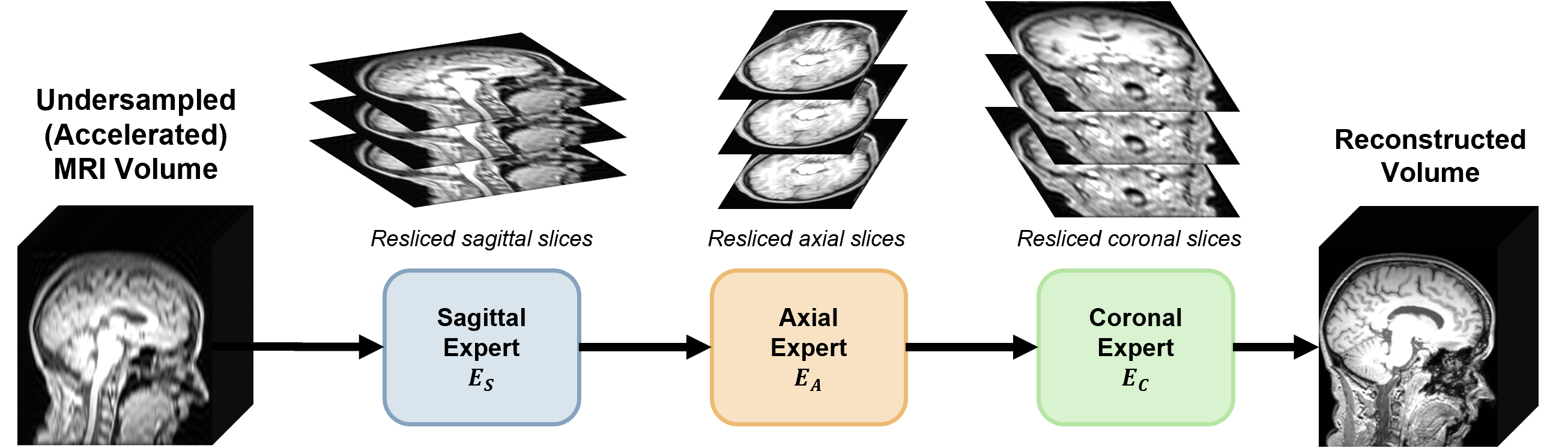
Methods: We developed View-Specialized Sequential Refinement (VSSR), a post-processing framework that operates on reconstructed images without requiring access to raw scanner data, making it compatible with any vendor reconstruction pipeline. VSSR applies three plane-specific two-dimensional neural networks in sequence — sagittal, then axial, then coronal — with each network correcting residual errors left by the previous stage. We evaluated VSSR on 581 T1-weighted brain volumes from the public IXI dataset at 4× and 8× simulated acceleration, and prospectively on volumes acquired at Sheba Medical Center on a 1.5T Philips Ingenia scanner from healthy volunteers, comparing fully sampled acquisitions (4.58 minutes) against 4× accelerated acquisitions (1.13 minutes).
Results: On prospectively acquired data, VSSR improved mean cross-plane peak signal-to-noise ratio (PSNR) by 1.60 decibels over a conventional single-plane network, with corresponding gains in structural similarity and perceptual image quality metrics. On the IXI dataset at 8× acceleration, VSSR outperformed all comparison methods including a memory-intensive 3D network, while requiring four-fold less graphics processing memory. Performance gains were consistent across all three anatomical planes rather than favoring any single orientation.
Conclusions: Sequential plane-specialized refinement improves image quality consistency across anatomical planes in accelerated brain MRI. Because VSSR operates downstream of reconstruction, it can be integrated into existing clinical workflows without scanner modification, supporting shorter acquisitions while preserving multi-planar image quality.