
Can Functional Language Areas Be Mapped without Functional MRI?
2School of Electrical and Computer Engineering, Tel-Aviv University, Israel
3fMRI Unit, Department of Neurology, Hadassah Medical Center, Israel
Background:
Functional magnetic resonance imaging (fMRI) is widely used for preoperative language mapping, but it is a relatively long examination that requires dedicated acquisition protocols, specialized analysis, and active patient cooperation. It is also susceptible to noise, motion artifacts, and other sources of signal degradation, which may limit its reliability or feasibility in some patients. In contrast, structural and diffusion MRI are commonly acquired as part of clinical brain MRI protocols and provide detailed anatomical and white-matter connectivity information. This raises an intriguing question: can routinely acquired non-functional MRI contain sufficient information to approximate the location of functional language areas?
Methods:
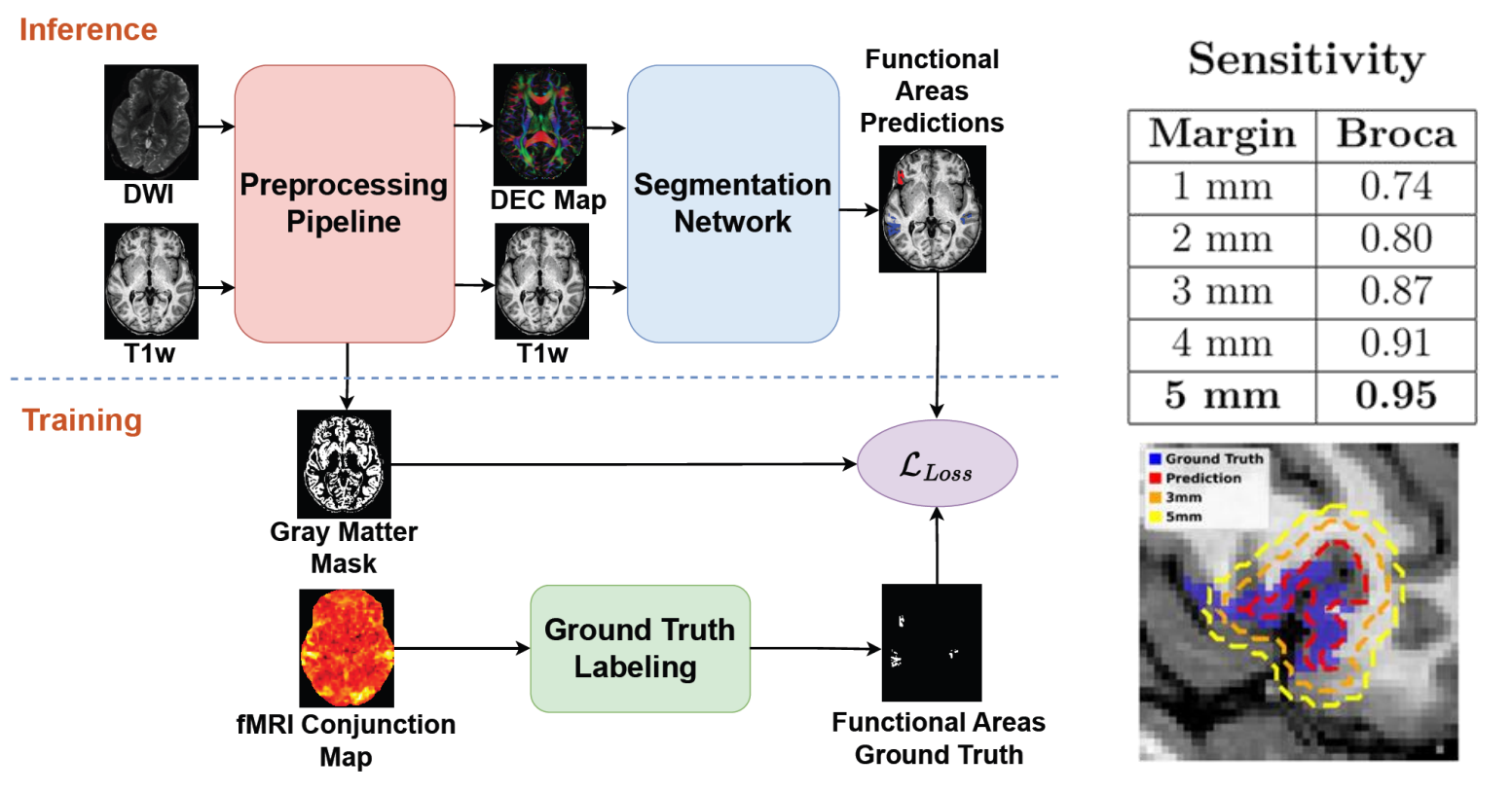
Thirty patients with drug-resistant epilepsy who underwent preoperative T1-weighted imaging, diffusion-weighted imaging, and task-based fMRI were retrospectively evaluated. A deep learning framework was trained to predict patient-specific Broca and Wernicke regions using T1-weighted images and diffusion tensor imaging-derived directional maps, without fMRI as input. Task-based fMRI language maps, derived from three language tasks and verified by an fMRI expert, served as ground truth. Performance was evaluated using five-fold cross-validation, receiver operating characteristic analysis, segmentation overlap, and sensitivity at safety margins of up to 5 mm.
Results:
The model achieved an area under the receiver operating characteristic curve of 0.95 for Broca and 0.88 for Wernicke localization. At the segmentation operating point, sensitivity was 0.58 and 0.43, respectively, with specificity of 0.99 for both regions. With a 5-mm safety margin, sensitivity increased to 0.95 for Broca and 0.80 for Wernicke.
Conclusions:
Our findings suggest that the answer may be yes. Structural and diffusion MRI appear to contain information that may enable approximate, patient-specific localization of functional language regions. The results do not establish an alternative to task-based fMRI, but support further investigation of non-functional MRI as a potential complementary source of information for preoperative language mapping.