Transition of boundary layer in hypersonic flow is characterized by changes in wall heat flux, which increases drastically from laminar to turbulent, making it an important phenomenon to study for hypersonic aircraft design. Though the onset of fully turbulent boundary layer is a critical location in terms of wall heat flux, the onset of transition itself may involve erratic unsteady heat flux behaviour [1] depending on the mechanism of transition. Moreover, there are very few such studies in shock tunnels which tend to have different free stream noise levels than continuous flow facilities where lot of data is available [2][3]. Shortage of shock tunnel boundary layer transition data is also evident in empirical correlation attempts [4][5] where mostly wind tunnel data is used.
In view of the above, surface heat flux measurements in HST4 shock tunnel in LHSR, IISc, have been initiated to look into hypersonic boundary layer in Mach 7 flow over a sharp cone. The cone model is 800 mm long with a half angle of 24deg. The right circular cone model surface (Fig.1) is flush mounted with platinum thin film sensors that are placed along a ray on the surface with the MACOR substrate, backing the thin films, polished with the cone surface to a smooth finish. 34 such gauges are present on the model to provide data at various locations along the length.
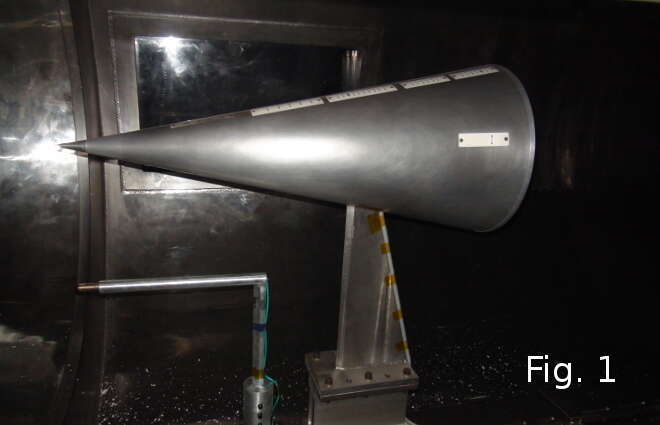
The HST4 shock tunnel has a nozzle exit diameter of 1 m. The shock tunnel is operated in low enthalpy condition to provide required Reynolds number and test time, which is achieved by using a mixture of He and Nitrogen on the driver side and keeping a high driven pressure. The Mach 7 air flow involves a Reynolds number of around 3.5 million per meter and enthalpy of 1 MJ/kg with a test time of 1.5-2 milliseconds. Experiments have been conducted with and without sand paper trips to create distinction between disturbed and undisturbed flow. The sand paper strip is attached near the tip of the cone and ends just before the first thin film sensor. Undisturbed flow boundary layer is expected to tend towards natural transition whereas disturbed boundary layer would take a bypass route to transition. By doing this a comparison of unsteady heat flux of both cases can be made. A sample measurement of wall heat flux with and without trips is shown in Fig.2.
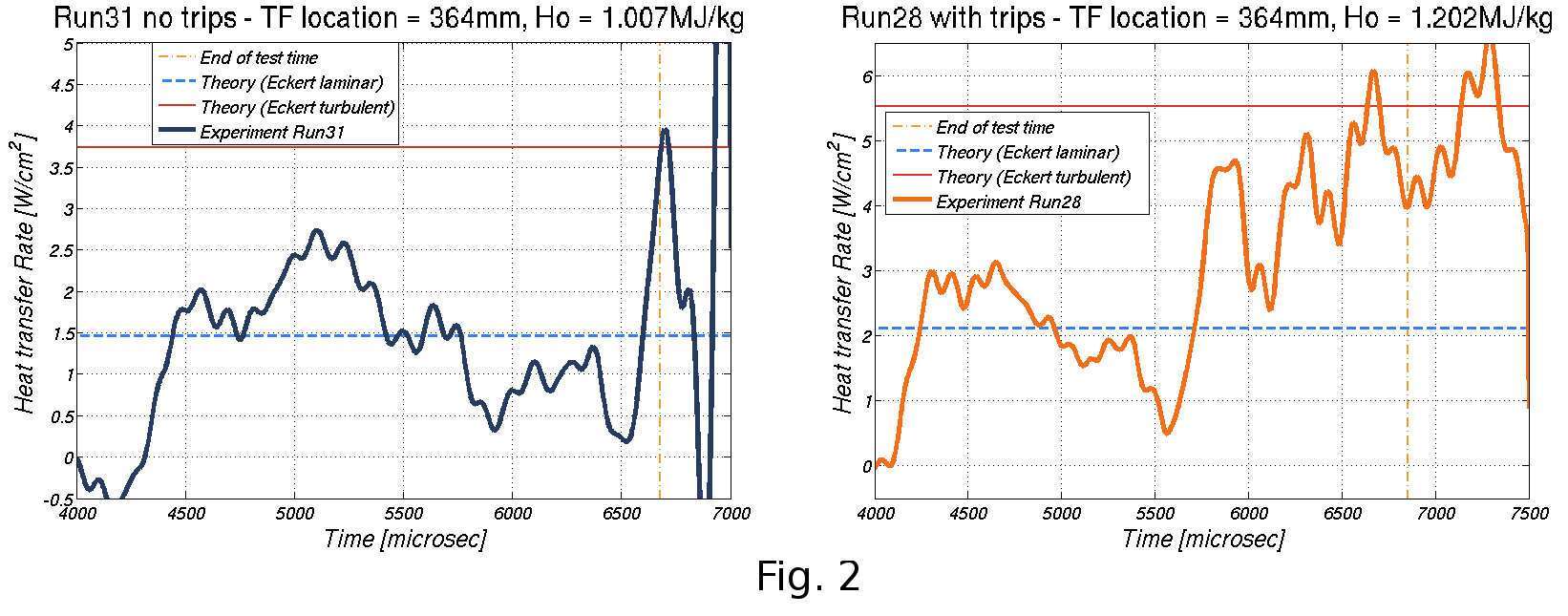
The general trend in most experiments seems to show fluctuations tending to turbulent values towards the later part of the test time. Further investigation with different conditions and tripping surfaces along with experiments with schlieren visualization are under way. The results of these cases will be presented in the conference.
References:
[1] “Transition Measurements on a 5 Degree Cone in the T4 Shock Tunnel”, David J. Mee, Research Report Number 2001-2, The University of Queensland, 2001.
[2] “Effects of High Speed Tunnel Noise on Laminar-Turbulent Transition”, Steven P. Schneider, Journal of Spacecrafts and Rockets, Vol. 38, No.3, 2001.
[3] “Free-stream density perturbations in a reflected-shock tunnel”, N.J.Parziale, J.E.Shepherd, H.G.Hornung, Experiments in Fluids, Vol. 55, 2014.
[4] “Measurements and Correlations of Transition Reynolds Numbers on Sharp Slender Cones at High Speeds”, S.R.Pate, AIAA Journal, Vol. 6, No. 6, 1971.
[5] “Laminar-Turbulent Transition Correlation in Supersonic/Hypersonic flow – Attached versus Separated flow”, George A. Simeonides, 26th International Congress of the Aeronautical Sciences, 2008.
