A Mixing layer forms between two fluid streams that differ in their momentum, composition and energy. Supersonic ejectors, supersonic inlets and combustion chambers are a few of many aerospace applications where this flow phenomenon is encountered. Compressibility is a key feature of these internal gasdynamic flows. Earlier investigations on the compressible mixing layer have found that there is a predominant detrimental effect of compressibility on the growth rate of the mixing layer [1,2]. The growth rate of mixing layer reduces drastically with increase in convective Mach number of the flow. Previous experimental studies on compressible mixing layers used a template setup where two gaseous flows of different Mach numbers were produced in carefully constructed ducts such that the static pressure was maintained as constant as possible.
However, in actual engineering applications this is seldom the case and the internal flows face varying pressures and cross sectional area. A particular example is the supersonic ejector which has been extensively studied by the author recently [3]. It was observed in the experimental investigations that the mixing layer is subjected to different pressure gradients caused due to change in area of cross section as well as due to the impingement of shocks that are naturally present in supersonic flow. Unsteadiness associated with such interactions were observed and quantified. This motivates the current studies which aims to fundamentally look at the evolution of a compressible mixing layer in a confined duct with imposed pressure gradients. The pressure gradient may be inherently present due to the flow topology or introduced by varying the area of the duct.
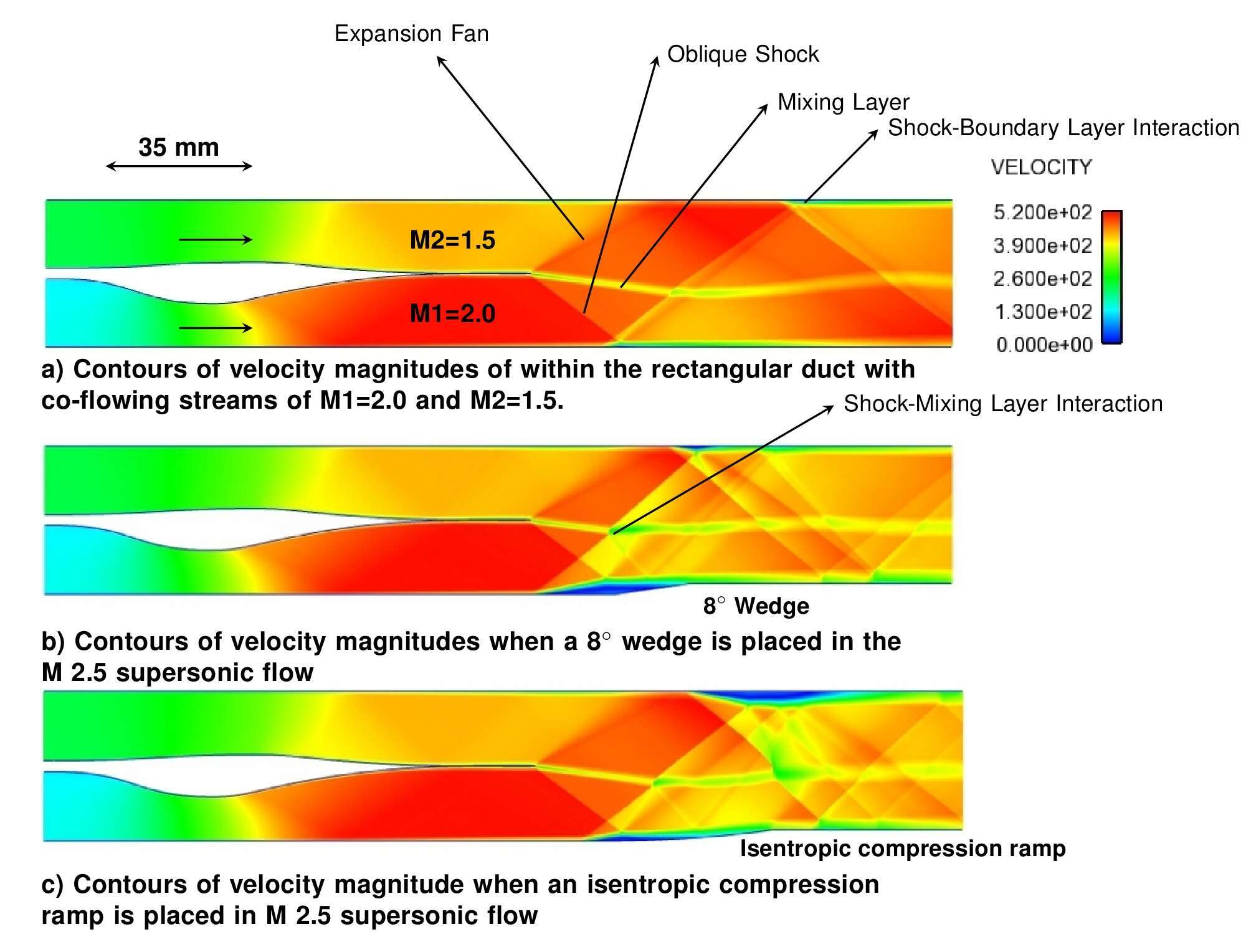
Figure 1 shows velocity contours within a rectangular duct containing a mixing layer formed between a Mach 2 and Mach 1.5 flow. The results are obtained by numerical simulations on a 2D computational grid using Ansys Fluent 15. Figure 1 a) represents the reference case where the two flows are bound by straight walls of the duct. However, the difference in Mach number produces a difference in static pressure which causes an oblique shock in Mach 2 flow and an expansion fan in Mach 1.5 flow. These waves criss-cross the duct length, and as they do so they interact with the mixing layer affecting its evolution in the duct. The boundary layers at the walls are disturbed by the impingement of a shock wave. Figures 1 b) and 1 c) show two cases where an area change is introduced into the Mach 2 flow which causes flow turning as well as additional adverse pressure gradients in the flow. A 8o wedge is used in case b) while in case c) the area change is made more gradual by an isentropic surface. The figures show a complex evolution of flow features including a system of shock - expansion waves that affect both the boundary layer and the mixing layer.
The wedge represents a rapid change in area, introducing significant flow turning that can cause shock of significant strength in the flow. The isentropic compression ramp is a gradual change in area where the pressure gradient is gradual but applied over a longer distance. Thus, it is seen that the wedge not only produces an oblique shock, but separates the boundary layer ahead of it. The shock from the wedge interacts with the mixing layer and passes into the M 1.5 flow where it disturbs the boundary layer at the top wall. When the isentropic compression ramp is used, no severe boundary layer separation is observed ahead of the compression ramp due to a decrease in adverse pressure gradient. The prolongation of the pressure gradient, however, leads to an extended separation region at the top wall. The separated boundary layers introduce additional streamline curvatures and cause further changes to the mixing layer evolution. Shock-boundary layer interactions are inherently unsteady and so is the mixing layer-shock interaction. Thus, in a flow system containing both flow phenomena each can modify the other.
Detailed studies using experimental and numerical tools are to be conducted with an aim to fundamentally understand the complex flow system that develops within a confined duct carrying two flows of different Mach number subjected to changes in area and pressure. The results shall be discussed in the final paper.
