In the recent years, world-wide interest has been focused on re-entry and inter-planetary missions [1, 2]. At re-entry velocities strong shock waves are generated ahead of nose part of a space vehicle. When a space vehicle re-enters into atmosphere, the high-temperatures behind the shock waves could excite the vibration mode and also cause dissociation and ionization within the gas, leading to a change in the thermodynamic properties of air. The heat generated at the temperatures behind the shock waves is very high so that effective thermal protective system is needed to have a successful re-entry. In order to design the effective thermal protection system, it is important to study the characteristics of the highly radiative flow behind the shock layers generated ahead of nose part of a vehicle.
Many studies have been reported on radiation measurements on Mars atmosphere using non-intrusive optical diagnostic techniques. Eichmann [1] used emission spectroscopy method to measure cyanogen radical (CN) species during a spacecraft entry into Mars atmosphere. David Buttsworth et al. [2] measured near-UV emissions for the re-entry of JAXA’s Hayabusa using emission spectroscopy. Moreover, studies on temperature measurements at hyper velocities are reported using Laser Induced Florescence (LIF), Coherent anti-Stokes Raman Spectroscopy (CARS) [3].
In the present research, experiments will be performed in order to find out the dominating species in the radiating flow field behind the shock layer of a blunt shaped model using emission spectroscopy method. Emission spectroscopy technique will be used to do experiments at Laboratory for Hypersonic and Shockwave Research, Department of Aerospace Engineering, IISc. Experiments are to be carried out in Free-piston Hypersonic Shock Tunnel (HST3) at Mach number of 8 with an enthalpy of 6 MJ/kg. Figure 1 shows the experimental setup to be used for the present research. As it can be seen from Fig.1, spectrograph and ICCD camera will be used for present research. Spectrograph captures the emission intensity for the spectral range of interest. Figure 2 shows the blunt shaped test model will be used in the present set of experiments. ICCD camera will be used to get the radiation images for the present experimental setup, which gives the brief idea about the radiating shock layer. For the present work, experiments will be done to find out the species in ultraviolet region and visible region; specifically experiments will be performed to find N2+ and NO species within the range of interest. The images obtained from ICCD camera will be calibrated in order to get radiative heat transfer rates at a later stage of experiments. The details of experimental setup and results will be discussed in full length paper.
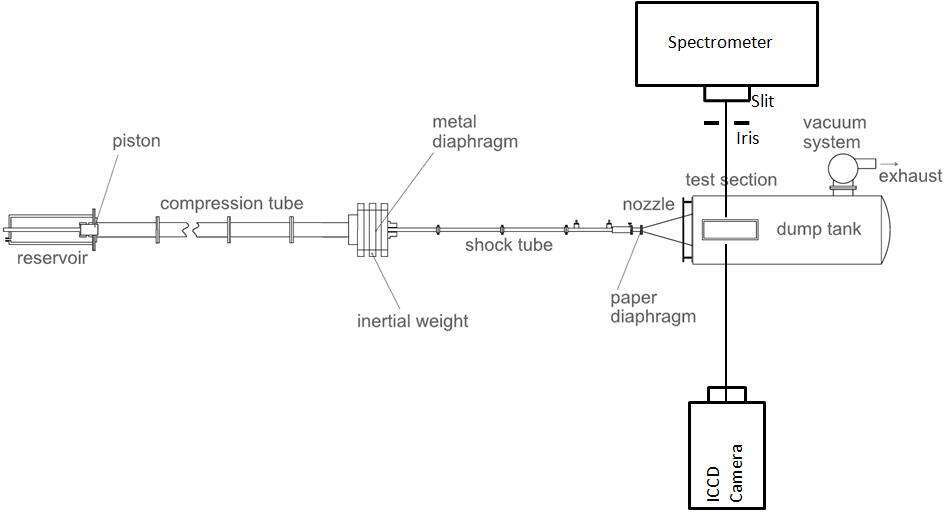
Fig 1: Experimental Setup
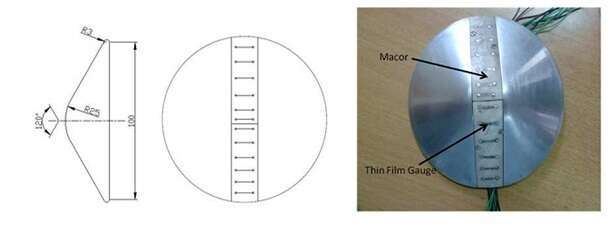
Fig 2: Blunt shaped test model
References:
- Troy Nicholas Eichmann, Radiation Measurements in Simulated Mars Atmosphere, PhD Thesis, the University of ueensland, Australia (2012)
- David Buttsworth, Richard Morgan, Peter Jenniskens, Near Ultraviolet Emission Spectroscopy of the Hayabusa Re-entry, 50th AIAA Aerospace Sciences Meeting including the New Horizons Forum and Aerospace Exposition, 09-12 January, Nashville, Tennessee (2012)
- Koreeda, J., Ohama, Y., Honma, H., Imaging Spectroscopy of Non-Equilibrium Shock Front Radiation in Air, Shock Waves 8(2) (1998)
