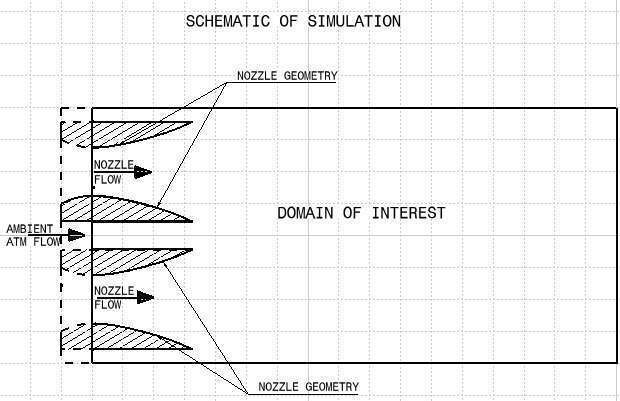
The arrangement of nozzles in linear clusters is a necessary practice in vehicles intended for orbital ventures. However, such setups exhibit a degree of unpredictability in the exhaust flow field. The ambiguity in the understanding of flow physics stems from the high degree of rarefaction, immense heating and numerous interactions between shocks and expansion fans. The purpose of this research is to study these interactions from a computational stand point and to analyze the resulting series of interactions and reflections.
The Navier-Stokes based CFD study in such regions has misgivings and is thus, not a preferred methodology. In this research, we utilize the widely recognized, Direct Simulation Monte Carlo (DSMC), a inetic particle based method. An in-house 2-D, parallel, multispecies, polyatomic solver is used for the purpose of the study. The Variable hard sphere is used for modeling the elastic part of the collisions whereas the Larsen-Borgnakke (L-B) model is used to model the inelastic portion. The continuous and discrete models of L-B are used for rotational and vibrational modes respectively. Adaptive cells are used to accurately model collisions in regions of high number density. Sampling is done once steady state is reached. The macroscopic values are obtained by time averaging the sampled data.
The schematic of the study is presented in Fig.1. The crux of the study is the interaction of the plumes produced by the two divergent nozzles. The properties at the throat are obtained by isentropic calculations. The ambient atmosphere conditions are determined by the altitude at which the study is conducted. Due to computational constraints, the cluster is assumed to consist of two nozzles only. Moreover, we restrain the study to cold, non-reacting flows of argon and nitrogen gas.
Two sets of studies are conducted. In the first study the nozzle exhaust properties are maintained identical and the distance between them is varied. In the second study, the positions of the nozzles are maintained while the exhaust number density is varied. The ambition of the two studies is to simulate the effect of relative positioning of the nozzles and the throttling effect respectively.
References:
- A. Bird, Molecular gas dynamics and the direct simulation of gas flows, Oxford publications, 1994.
- Cheng, H. K., and G. Emanuel. "Perspective on hypersonic nonequilibrium flow."AIAA journal 3 (1995): 385-400.
- Kim, Kyu Hong, Chongam Kim, and Oh-Hyun Rho. "Methods for the accurate computations of hypersonic flows: I. AUSMPW+ scheme."Journal of Computational Physics 1 (2001): 38-80.
- Scanlon, T. J., et al. "An open source, parallel DSMC code for rarefied gas flows in arbitrary geometries."Computers & Fluids 10 (2010): 2078-2089.
- Shang, J. S., et al. "Interaction of jet in hypersonic cross stream."AIAA journal, 3 (1989): 323-329.
- Glaznev, V. N., and V. S. Demin. "Semiempirical theory of the generation of discrete tones by a supersonic underexpanded jet flowing over an obstacle."Journal of Applied Mechanics and Technical Physics6 (1976): 787-793.
- Candler, Graham V., and Robert W. MacCormack. "Computation of weakly ionized hypersonic flows in thermochemical nonequilibrium."Journal of Thermophysics and Heat Transfer 3 (1991): 266-273.
- Grasso, F., and M. Marini. "Analysis of hypersonic shock-wave laminar boundary-layer interaction phenomena."Computers & fluids 6 (1996): 561-581.