Study of mechanical properties of nanoporous gold with and without hard coating obtained by molecular dynamics simulations
Nanoporous gold is a material widely studied since it finds its application in several fields (actuation, catalysis, detection of biological molecules or biological signals, for example). It is known that its mechanical properties deviate from the Gibson-Ashby scaling law [1] towards a less rigid and less resistant behavior. Moreover, this material fractures in a brittle manner in tension unlike non-porous gold (bulk, nanowires...). It is interesting to understand these particular mechanical properties at the atomic scale and examine whether those could be improved.
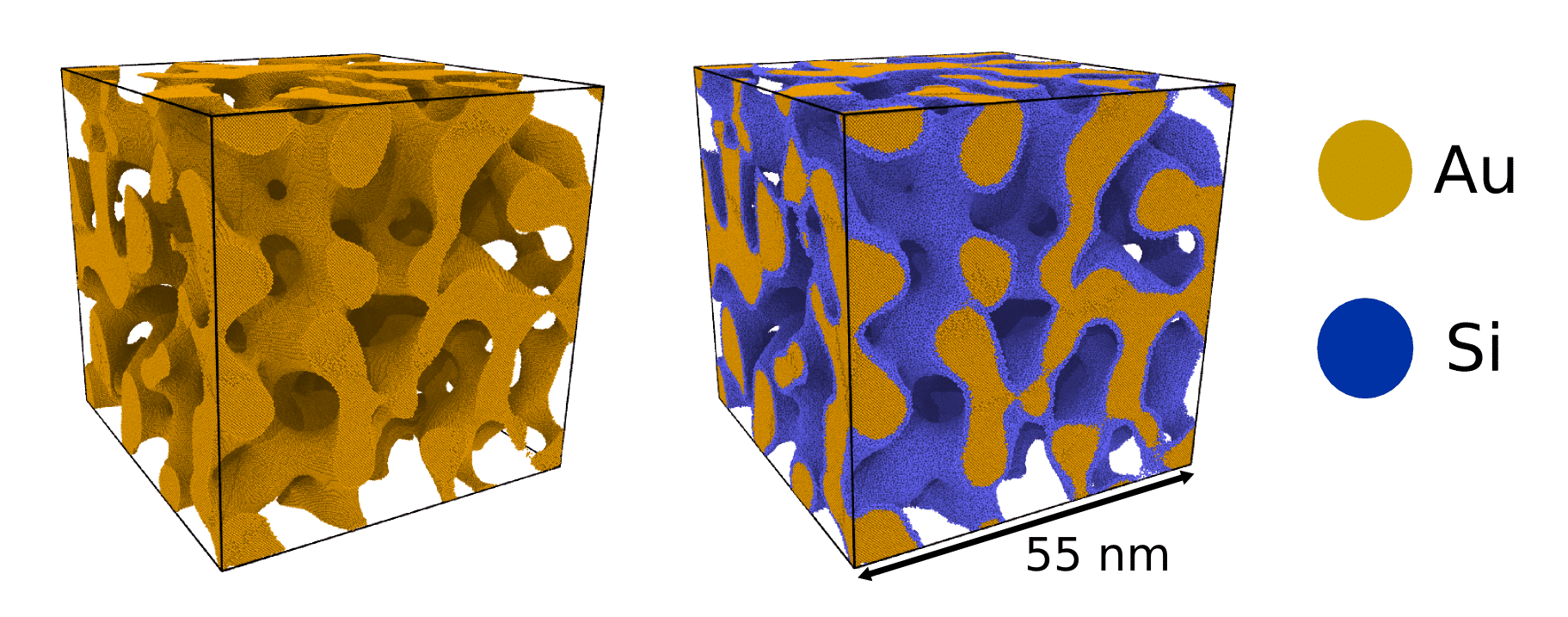
Here we investigate by molecular dynamics how a hard amorphous coating modifies the mechanical behavior of nanoporous gold. Indeed, interfaces act as a source of plasticity and can enhance the ductility of the structure. In this presentation, we briefly discuss the method developed to construct realistic atomistic models [2], then we compare the mechanical properties and deformation mechanisms of nanoporous gold with and without coating in tension and in compression. Tensile tests indicate that the plasticity is less localized in the coated structure while the fracture remains localized in a plane of thickness of 10-20 nm in all cases. Compression tests show that the deformation takes place by a global and progressive densification of the structure, not indicative of a fragile behavior.
References
[1] L.J Gibson et M. F. Ashby, Cambrige Solid State Science Series (1997)
[2] M. Guillotte et al., Computational Materials Science (2019)

Powered by Eventact EMS